Overview
Built during my data science internship at Personifwy: a supervised text-classification pipeline that labels SMS messages as spam or legitimate (ham).
The model reached a reported 98% classification accuracy. This write-up covers the pipeline and, just as importantly, what that number does and doesn't tell you.
The problem
SMS spam detection is a classic binary text-classification problem: given a short message, decide whether it is spam or a legitimate ("ham") message. SMS text is short, informal, and full of abbreviations, so the pipeline has to turn noisy text into features a model can learn from.
Pipeline
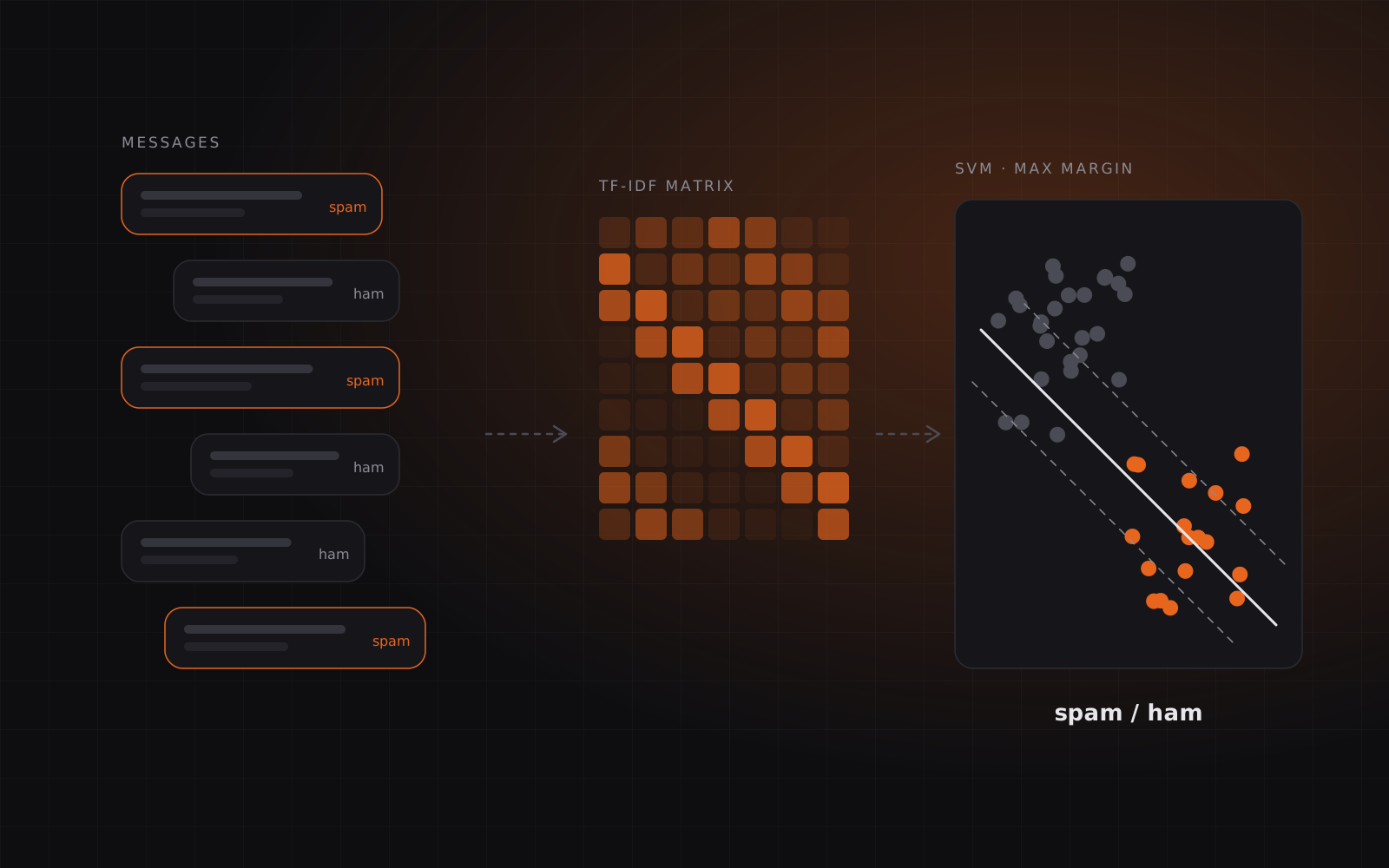
From raw messages to a spam/ham prediction.
6 layers · select a layer for details
-
Input Labelled SMS messages
Short text messages labelled as spam or ham.
-
Preprocess Text cleaning & normalization
Raw text is cleaned so formatting noise doesn't become a feature.
- Python
-
Features TF-IDF vectorization
Messages become sparse, term-weighted vectors.
- scikit-learn
- TF-IDF
-
Model Support Vector Machine
A binary classifier trained on the TF-IDF features.
- SVM
-
Tuning GridSearchCV
Cross-validated search over hyperparameters.
- GridSearchCV
-
Output spam / ham
Predicted label, evaluated with classification accuracy.
Approach
Text preprocessing
Messages were cleaned and normalized before feature extraction, so that superficial differences in formatting wouldn't become features in their own right.
Feature extraction with TF-IDF
TF-IDF (term frequency–inverse document frequency) turns each message into a sparse vector that weights words by how characteristic they are of that message relative to the whole collection. Words that appear everywhere count for little; distinctive ones — the kind common in promotional spam — count for more.
Training a Support Vector Machine
A Support Vector Machine learns a decision boundary that separates the two classes with the widest possible margin. SVMs work well with high-dimensional, sparse features like TF-IDF vectors.
Hyperparameter tuning with GridSearchCV
GridSearchCV evaluated combinations of model hyperparameters with cross-validation and selected the best-performing configuration.
Results
The final model achieved a reported 98% classification accuracy on the project's evaluation data.
Limitations
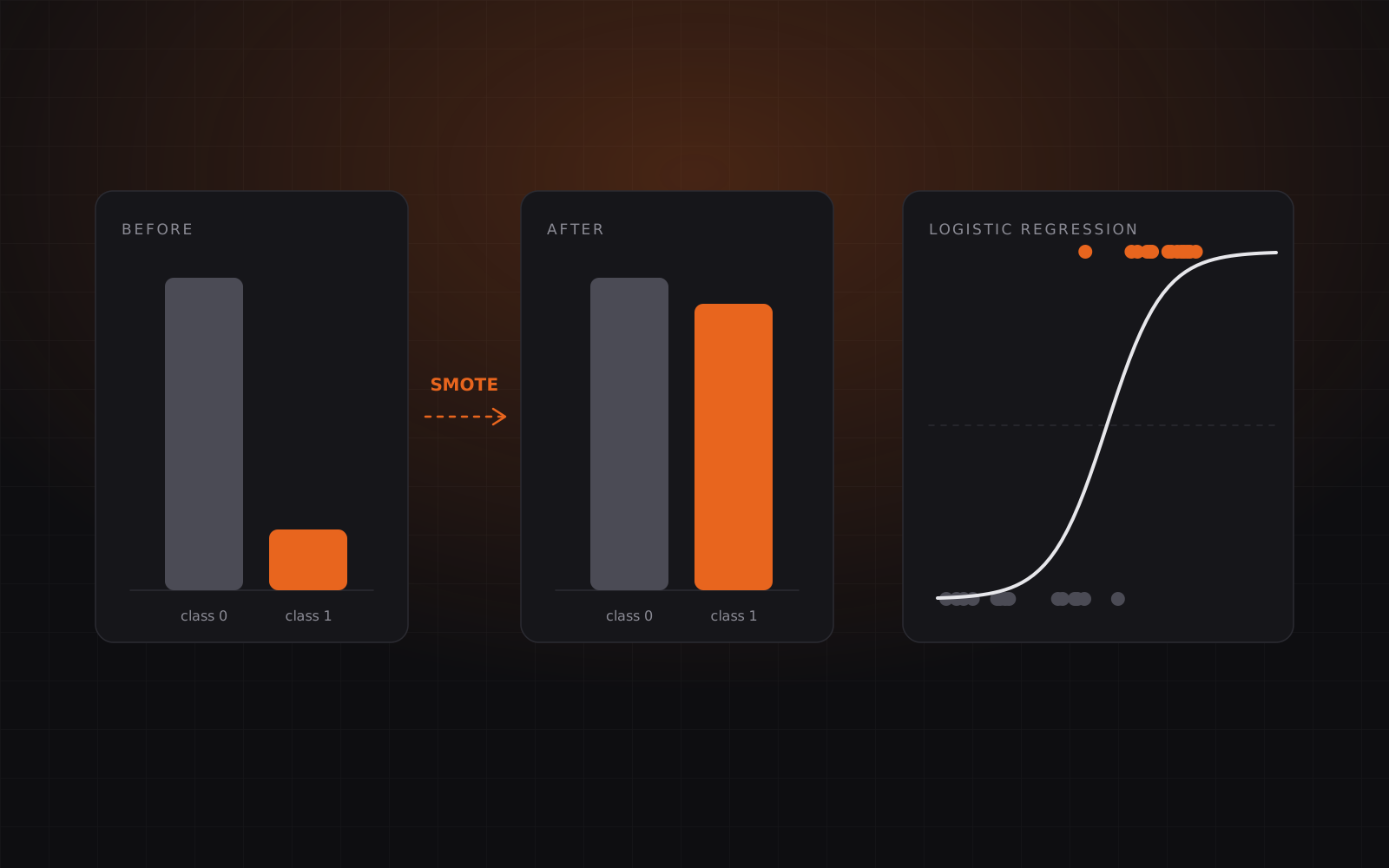
- Accuracy isn't the whole story. Spam datasets are usually imbalanced, so a model can score highly on accuracy while still missing spam. Precision, recall, and a confusion matrix give a fuller picture — they're what I'd report alongside accuracy in a follow-up.
- Results are dataset-dependent. Performance was measured on the project's dataset. Spam patterns change over time and across regions, so results won't automatically transfer to other message sources.
- A learning project, not a live filter. This was built as an internship project, not as a production filtering service.