
Introduction
When you sign in to an app, book an appointment, search for a product, or submit a form, a lot happens behind the screen. The application needs to receive your request, check that it is valid, apply the right rules, retrieve or save information, and return a useful response.
That is where a backend developer comes in.
Backend developers build and maintain the server-side systems that power websites and applications. Their work is less visible than the interface, but it helps determine whether the product behaves correctly, protects information, and performs reliably.
If you are a founder planning a web application—or a student exploring software development—understanding backend developer responsibilities can help you make better technical and career decisions.
What Is Backend Development?
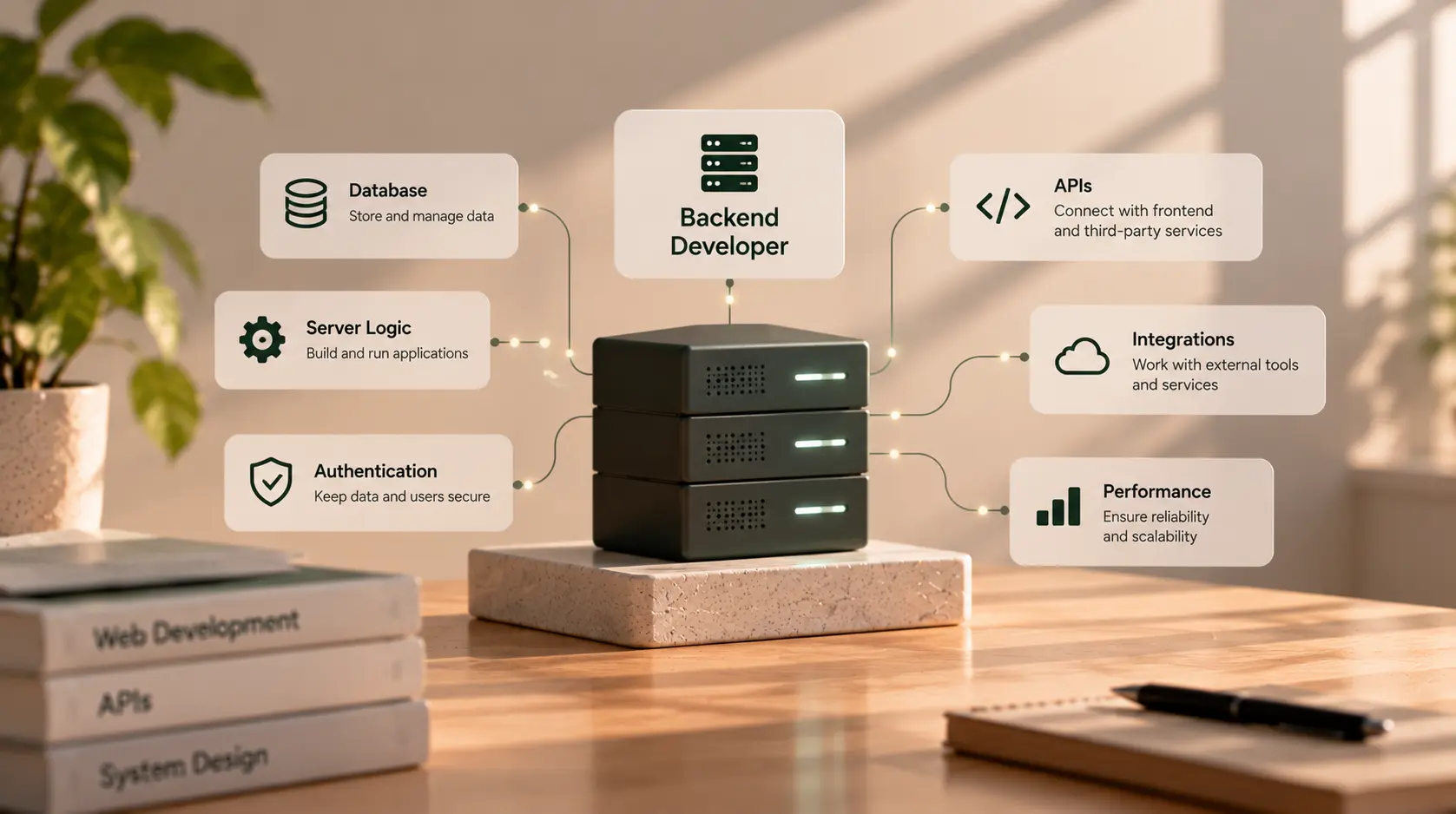
Backend development is the work involved in building the server-side part of an application. It typically includes application logic, APIs, databases, authentication, integrations, and the systems that allow an application to run.
Think of an appointment-booking app. The frontend displays available time slots and lets a user choose one. The backend checks whether the slot is still available, verifies the user, saves the booking, and may trigger a confirmation email.
The frontend presents the experience. The backend applies the rules and manages the data behind it.
What Does a Backend Developer Do?
The exact responsibilities depend on the product and team, but backend developers commonly work across these areas.
1. Build application logic
Application logic defines what should happen when someone uses a product. A backend developer translates business requirements into code that handles these actions consistently.
For example, in an online store, backend logic may calculate an order total, check stock availability, apply an eligible discount, and record the order. In a healthcare application, it might enforce rules about which users can access particular patient records.
Good backend logic reflects the real requirements of the business rather than simply making a button work.
2. Design and manage databases
Applications need to store information such as user accounts, bookings, orders, messages, and settings. Backend developers decide how that information should be organised and how the application will retrieve or update it.
Their work may include:
- Designing tables, fields, relationships, and constraints.
- Writing queries to create, read, update, and delete records.
- Keeping related data consistent.
- Creating database migrations as the product changes.
- Improving slow queries when performance becomes an issue.
- Working with backups and recovery processes where these fall within the team's responsibilities.
For example, a booking platform needs a sensible way to connect customers, service providers, appointments, and payments. A poorly designed data model can make features harder to build and increase the risk of inconsistent records.
3. Develop APIs
An API, or application programming interface, allows different parts of a system to communicate. A website or mobile app might request a user's profile from the backend through an API. The backend processes the request and returns a response, often in JSON format.
A backend developer may create endpoints for registration, login, search, booking, payments, or reporting. They also define how requests should be validated, what data should be returned, and how errors should be communicated.
APIs matter because the frontend should not need to know the internal details of the database. It needs a reliable, clearly defined way to request the information or actions it requires.
4. Implement authentication and permissions
Applications often need to know who a user is and what that user is allowed to do.
Authentication verifies identity, such as through a login process. Authorization determines what an authenticated user can access or change.
A backend developer may implement account registration, password-reset flows, session or token handling, role-based permissions, and access checks. In an application with administrators, staff, and customers, each role may need different permissions.
Security is not just about adding a login screen. The backend must check permissions when protected data or actions are requested, rather than assuming that the interface will prevent every unauthorised action.
5. Connect third-party services
Many applications rely on external services rather than building every capability from scratch. These might include payment providers, email platforms, calendar systems, customer relationship management tools, or identity services.
Backend developers integrate these services, handle their responses, and plan for failures. An external service can be slow, temporarily unavailable, or return an unexpected error, so the integration needs appropriate validation and error handling.
For example, after a customer completes a purchase, the backend may communicate with a payment provider and update the order status based on the verified result. The details depend on the provider and the application's requirements.
6. Test, debug, and maintain code
A backend feature is not complete just because it works once on a developer's machine. It needs to behave correctly in expected situations and handle invalid input or failure cases.
Backend developers may write unit tests for individual functions and integration tests for interactions between components. They also investigate bugs, read logs, reproduce errors, and fix problems reported by users or testers.
Testing is especially important for rules involving payments, bookings, permissions, and data updates, where an unnoticed defect can have consequences beyond a visual glitch.
7. Help deploy and monitor applications
Backend code must run in an environment users can access. Depending on the team, backend developers may help configure production settings, environment variables, database connections, application servers, and deployment processes.
After release, they may investigate errors, check performance, review logs, and improve slow or unreliable operations. In some organisations, dedicated DevOps, platform, or site reliability engineers own much of this work; in smaller teams, backend developers may handle more of it themselves.
Deployment is not always the backend developer's sole responsibility, but understanding how the application runs in production helps them build and troubleshoot it effectively.
Which Tools Do Backend Developers Use?
There is no single required technology stack. Tools depend on the product, team, and existing codebase.
| Area | Common examples | What they are used for |
|---|---|---|
| Programming languages | Python, JavaScript/TypeScript, Java, PHP, C# | Writing server-side logic |
| Frameworks and runtimes | Django, FastAPI, Node.js, Spring, Laravel, ASP.NET Core | Structuring and running backend applications |
| Databases | PostgreSQL, MySQL, SQLite, MongoDB | Storing and querying application data |
| API tools | Postman, Insomnia, command-line HTTP tools | Sending requests and checking API responses |
| Version control | Git, GitHub, GitLab | Tracking changes and collaborating |
| Testing | pytest, JUnit, Jest, framework-specific tools | Checking behavior and preventing regressions |
| Deployment and operations | Cloud platforms, containers, logs and monitoring tools | Running applications and investigating production issues |
A developer does not need to master every tool in this table. It is generally more useful to understand the underlying concepts and become confident with the tools required by a particular project.
What Does a Backend Developer's Day Look Like?
A typical day might include reviewing a feature request, discussing requirements with a product manager, implementing an API endpoint, updating a database model, writing tests, and reviewing another developer's code.
They might then investigate a bug, coordinate with a frontend developer about an API response, or help prepare a release. The balance varies: a small team may involve broad ownership, while a larger team may divide responsibilities more narrowly.
The important point is that backend development is not only writing code. It also involves understanding requirements, making technical decisions, testing assumptions, communicating with teammates, and maintaining existing systems.
When Does a Business Need a Backend Developer?
A business may need backend development when its product must do more than display static information. Common examples include:
- User accounts and role-based access.
- Booking, ordering, or payment workflows.
- Data storage and reporting.
- Integrations with external platforms.
- Admin dashboards and internal tools.
- Automated notifications or background tasks.
- Complex business rules that must be applied consistently.
A simple brochure website may need very little custom backend code. A web application with users, permissions, records, and connected services may need substantial backend work.
If you are planning a product, define the user workflows and data requirements before deciding which technologies or team structure to use. A clear web project brief template can help you organise the scope before discussing estimates with a developer.
What Skills Should a Backend Developer Have?
The most useful skills depend on experience level and project needs, but a strong foundation usually includes:
- Programming fundamentals: functions, data structures, error handling, and readable code.
- HTTP and APIs: requests, responses, status codes, validation, and API design.
- Database knowledge: data modelling, SQL, relationships, and query basics.
- Security awareness: authentication, permissions, safe handling of secrets, and input validation.
- Testing and debugging: reproducing issues and verifying that changes work.
- Version control: using Git to track and collaborate on code.
- Communication: explaining trade-offs, asking questions, documenting decisions, and coordinating with frontend or product teammates.
Students do not need to learn every framework at once. Choose one language and framework, build a small project, connect it to a database, create a few APIs, test them, and deploy the result. A complete, well-explained project often demonstrates understanding more clearly than a long list of technologies.
Backend Developer vs Full-Stack Developer
A backend developer primarily focuses on server-side logic, APIs, databases, and related system behavior. A full-stack developer works across the backend and the frontend—the part users see and interact with.
A founder building a focused MVP may find a full-stack developer useful if the scope is manageable and one person can reasonably own the work. A product with demanding backend requirements may benefit from a dedicated backend specialist. The right choice depends on the complexity, risks, and workload of the project.
If you are comparing hiring options, see the guide to hiring a full-stack developer versus separate frontend and backend developers.
Final Thoughts
A backend developer builds the systems that make an application behave as intended: the business logic, APIs, data structures, permissions, integrations, tests, and sometimes deployment processes behind the interface.
For founders, understanding these responsibilities helps clarify what a project requires and what to discuss before hiring. For students, it provides a practical roadmap: learn programming fundamentals, understand HTTP, work with a database, build APIs, add security and tests, and deploy a small application.
The tools will change from project to project, but the core goal remains the same: build backend systems that are understandable, reliable, secure, and suited to the problem they need to solve.