
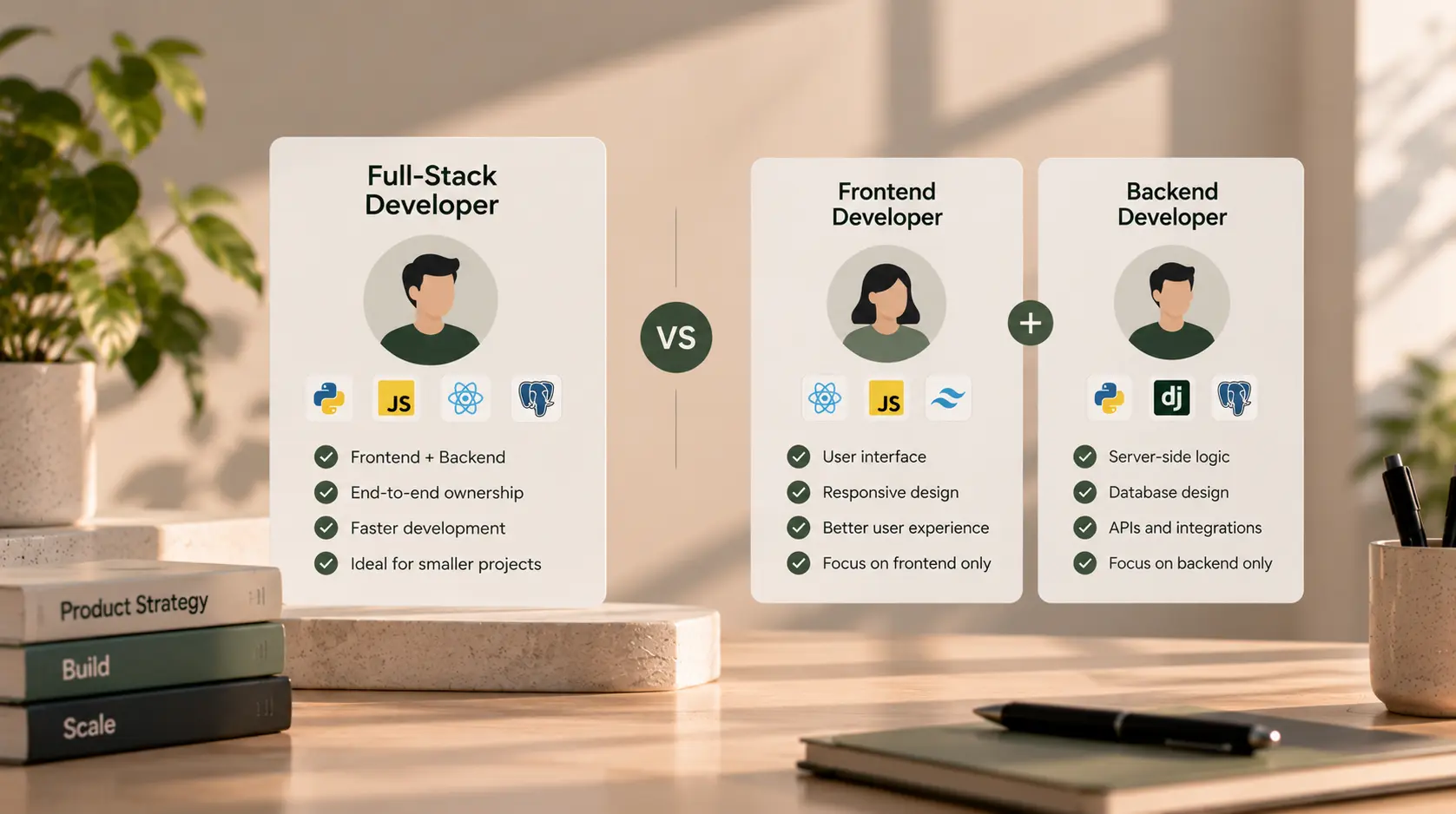
Full-Stack vs Frontend and Backend Developers: Who to Hire?
When you are building a web application, one of the first hiring decisions is whether to work with one full-stack developer or hire two specialists: one for the frontend and another for the backend.
At first, two developers may sound like the safer option. One focuses on the interface, while the other handles the server, database, and APIs. But for a small team, that setup can also introduce extra coordination, handoffs, and decisions before the product is even validated.
A full-stack developer can work across both sides of an application, which may make it easier to build and change features end to end. However, the title alone does not guarantee deep expertise in every area. Some products genuinely benefit from dedicated frontend and backend specialists.
The right choice depends on the work your product needs now—not on which team structure sounds more established.
What Is the Difference Between Full-Stack, Frontend, and Backend Developers?
A frontend developer focuses on the part of an application that people see and interact with. A backend developer works on the logic and systems behind that interface. A full-stack developer works across both areas and can often deliver a feature from the user interface through to the database or API.
| Role | Main responsibilities | Best fit when |
|---|---|---|
| Frontend developer | User interface, responsive layouts, browser behavior, accessibility, client-side state, and visual performance | The user experience or interface is a major source of product complexity |
| Backend developer | APIs, business logic, databases, authentication, integrations, background jobs, and server-side reliability | Data, integrations, security, or system architecture are the main technical challenges |
| Full-stack developer | A combination of frontend and backend work, often owning complete features across the application | You need one person to build and iterate across the whole product |
These roles are not rigid boxes. Frontend developers may need to investigate API issues, and backend developers may need to understand how a feature behaves in the browser. The distinction is about where each person brings the most depth, not about refusing to work outside their lane.
Option 1: Hire One Full-Stack Developer
For an early-stage product, a capable full-stack developer can be a practical first hire. Instead of splitting each feature across two people, one developer can often handle the interface, API, data model, and integration work needed to make that feature function.
Advantages of a full-stack hire
1. Fewer handoffs
A feature often crosses several layers. For example, adding a new customer field may require a database change, an API update, form validation, and a change to the user interface. With one person working across those layers, there may be fewer handoffs and fewer opportunities for assumptions to get out of sync.
2. Simpler communication
You have one primary engineering contact for a broad part of the product. That can make it easier to discuss requirements, prioritize fixes, and understand what is needed to release a feature.
3. Useful for changing requirements
Early products often change after founders speak with users or test an initial version. A full-stack developer who understands the whole workflow may be able to adjust a feature without coordinating several separate work queues.
4. A smaller initial team
One hire usually means one onboarding process, one main working relationship, and less day-to-day coordination. This can be valuable when a founder is also managing sales, customer research, operations, and funding.
5. End-to-end ownership
A good full-stack developer should be able to explain how a feature works across the stack, identify where a problem may be occurring, and take responsibility for getting the feature into a usable state—not just completing a narrow coding task.
Limitations of a full-stack hire
A full-stack developer is not automatically an expert in every frontend and backend technology. Many developers have a stronger area and a working understanding of the other side.
If your application has unusually complex user interactions, demanding performance requirements, complicated data processing, strict security needs, or significant infrastructure challenges, one generalist may not provide all the depth you need.
There is also a capacity issue. One developer can only work on so many things at once. If the roadmap is large or deadlines are tight, relying on a single person can create a bottleneck and concentrate important system knowledge in one place.
When a full-stack developer makes sense
Consider a full-stack hire when:
- You are building an MVP or the first version of a web application.
- The product has a relatively focused set of workflows.
- Frontend and backend work are tightly connected feature by feature.
- You need to test ideas and adjust requirements frequently.
- Your budget supports one experienced developer more comfortably than two separate hires.
- You need one person to take a feature from requirements through implementation and deployment.
For example, a small appointment-booking platform may need user registration, provider profiles, available time slots, booking forms, notifications, and an admin dashboard. If the scope is manageable, one experienced full-stack developer may be able to build the first version without needing separate specialists from day one.
Option 2: Hire Separate Frontend and Backend Developers
With separate specialists, one developer takes primary responsibility for the user-facing application, while the other focuses on server-side logic, data, APIs, and integrations.
This approach can be valuable when both sides of the product have substantial work and need focused technical ownership.
Advantages of separate specialists
1. More depth in each area
A frontend specialist may bring deeper experience with complex interfaces, accessibility, design systems, browser performance, and client-side state. A backend specialist may bring deeper experience with data architecture, integrations, security, asynchronous processing, and reliability.
That depth matters when the product needs it—not simply because the codebase contains both a frontend and a backend.
2. Parallel development
If the API contract and requirements are clear enough, frontend and backend work can progress at the same time. The backend developer can implement an endpoint while the frontend developer builds the screen against an agreed contract or mock data.
Parallel work is most effective when responsibilities and dependencies are understood. If the API keeps changing or both developers are waiting on each other, adding a second person may not improve delivery speed.
3. Clearer ownership for complex systems
As an application grows, different parts of the system may need distinct technical decisions. Separate specialists can take responsibility for frontend architecture and backend architecture, making it easier to give each area sustained attention.
4. More capacity across simultaneous workstreams
Two developers can work on different tasks at once when those tasks do not depend heavily on each other. This can help when the roadmap has enough meaningful frontend and backend work to keep both people productively engaged.
Limitations of separate specialists
1. More coordination
The developers need to agree on API endpoints, request and response formats, validation rules, error handling, authentication behavior, and how the interface should respond to backend states.
These decisions are normal engineering work. The cost comes when they are unclear, repeatedly revisited, or left until integration.
2. More dependencies between tasks
The frontend may be ready for an endpoint that is not complete, or the backend may change a response in a way that breaks the interface. Clear contracts and regular communication reduce this risk, but they do not remove it entirely.
3. A larger management commitment
Two developers mean two working relationships, two onboarding processes, and more coordination around priorities and delivery. If you do not have a technical lead, you may need to spend more time making sure their work fits together.
4. Potentially higher total cost
Two specialists will generally mean paying for more total developer time than hiring one person. However, cost should be compared against the work required, the depth of expertise needed, and the amount of coordination. A specialist may prevent expensive mistakes when the system genuinely needs that expertise.
When separate developers make sense
Consider separate frontend and backend developers when:
- Both the interface and backend have significant technical complexity.
- The product has many screens, complex interactions, or demanding accessibility requirements.
- The backend includes substantial integrations, data processing, security, or reliability work.
- You have enough work for both developers to progress in parallel.
- The API boundaries and product requirements are reasonably well defined.
- You have someone who can coordinate technical decisions and resolve cross-stack issues.
For example, a healthcare platform with detailed workflows, role-based permissions, third-party integrations, audit trails, and a complex clinical interface may need dedicated frontend and backend ownership. The decision should come from the actual requirements and risk—not merely from the fact that the product is in healthcare.
Full-Stack vs Separate Frontend and Backend Developers: Comparison
| Factor | One full-stack developer | Separate frontend and backend developers |
|---|---|---|
| Initial team size | Smaller | Larger |
| Coordination | Usually simpler for a focused product | More coordination across shared features |
| Parallel work | Limited by one person's capacity | Better when tasks can progress independently |
| End-to-end feature ownership | Often straightforward | Shared across specialists, requiring clear contracts |
| Technical depth | Depends on the developer's strengths | More focused depth in each area |
| Early product changes | Often easier when changes cross both layers | Can require coordination across both workstreams |
| Complex frontend or backend needs | May require outside specialist support | Dedicated ownership can be useful |
| Knowledge concentration | More context may sit with one person | Context is distributed, but boundaries must be documented |
| Best starting point | Focused MVPs and small product teams | Products with substantial, parallel frontend and backend demands |
There is no universal winner. Two specialists are not automatically faster, and one full-stack developer is not automatically cheaper in the long run. The best arrangement is the one that helps you deliver the required product reliably with the least unnecessary friction.
Which Option Is More Cost-Effective?
Do not compare only one developer's rate with the combined rates of two developers. Compare the cost of getting the product to the required standard.
For a focused MVP, a full-stack developer may be cost-effective because the workload is tightly connected and the product needs frequent changes. Hiring two specialists before there is enough work for both can add coordination without producing a matching increase in output.
On the other hand, choosing a generalist for a project that requires deep expertise in a difficult area can create rework, delays, or quality problems. A specialist can be worth the additional cost if their expertise addresses a real technical risk.
When comparing proposals, ask each candidate or team to estimate the same scope. Include:
- The features and workflows included in the first release.
- Frontend and backend requirements.
- Integrations and third-party dependencies.
- Testing, deployment, and documentation.
- Expected review and feedback cycles.
- Ongoing maintenance and support.
- Assumptions, exclusions, and likely change requests.
A proposal that appears cheaper may exclude important work. Compare deliverables and responsibilities, not just hourly rates or headline project prices.
How to Decide: A Practical Framework for Founders
Before writing a job description, list the work you need done over the next few months. Then classify each item as primarily frontend, primarily backend, or tightly connected across both.
Step 1: Identify the biggest technical risk
Ask what is most likely to prevent the product from working well.
- If the main risk is usability, interaction design, accessibility, or complex browser behavior, prioritize frontend expertise.
- If the main risk is data integrity, integrations, permissions, processing, or system reliability, prioritize backend expertise.
- If the main risk is getting a complete workflow built and tested quickly, a full-stack developer may be a strong fit.
Step 2: Check whether one person can own the scope
Look at the requirements—not just the number of technologies listed. A project can use several technologies and still have a manageable scope. Another project can use a simple stack but involve complex permissions, business rules, or reliability requirements.
Ask whether one experienced developer can realistically build, test, deploy, and maintain the first release within your constraints.
Step 3: Decide whether parallel work will genuinely help
Two people do not automatically mean twice the speed. Estimate how much of their work can happen independently and how much requires one person to finish before the other can proceed.
If the frontend depends on unsettled backend decisions every day, coordination may consume some of the extra capacity. If the API is stable and both sides have substantial independent work, separate specialists may be more effective.
Step 4: Consider what happens after launch
Someone needs to understand the complete system after the first release. Decide who will handle bug fixes, deployments, security updates, monitoring, and future changes.
If you hire separate developers, make sure cross-stack ownership and documentation are explicit. If you hire a full-stack developer, make sure critical decisions are documented and that the system does not depend entirely on undocumented knowledge held by one person.
Step 5: Hire for demonstrated ability, not the title alone
A person calling themselves a full-stack developer may have strong backend skills and basic frontend experience—or the reverse. Ask about the kind of projects they have actually delivered and which parts they personally owned.
For a more structured evaluation, use the questions in the web developer hiring checklist and prepare your requirements using the web project brief template.
A Hybrid Approach: Start Full-Stack, Add a Specialist Later
You do not have to choose a permanent team structure before the product exists.
A practical approach for many founders is to start with a capable full-stack developer who can build the initial product and learn where the real constraints appear. As usage, feature complexity, and workload grow, bring in a frontend or backend specialist to address the area that needs more depth.
For example:
- Start with a full-stack developer while validating the core product workflow.
- Add a frontend specialist if interface complexity, accessibility, or design consistency becomes a major challenge.
- Add a backend specialist if data architecture, integrations, security, or reliability requires deeper ownership.
- Keep the boundaries collaborative so that developers can still solve problems across the complete product.
This is not a rule that every company should follow. If the product clearly requires specialist expertise from the beginning, hiring that expertise early can be the more sensible decision.
Common Hiring Mistakes to Avoid
Hiring two people because it sounds more professional. Team size should follow the workload and complexity, not an assumed organizational standard.
Expecting one developer to be an expert at everything. Ask where the candidate has depth and where they have practical working experience. Make sure those strengths match your project's risks.
Treating traffic as the only reason to specialize. Complexity can come from data, security, integrations, accessibility, or business rules even when an application has relatively few users.
Ignoring integration work. Frontend and backend development must come together into a working product. Include API contracts, testing, error handling, and deployment in the plan.
Choosing based only on the lowest quote. A low initial price does not help if key features, testing, documentation, or maintenance are excluded.
Failing to define ownership. Whether you hire one person or two, establish who makes technical decisions, reviews changes, deploys releases, and handles production issues.
Frequently Asked Questions
Is it better to hire one full-stack developer or two specialists?
For a focused MVP or a small product with tightly connected features, one capable full-stack developer can be a practical choice. Separate specialists are more useful when frontend and backend work both require significant depth and can progress in parallel.
Is a full-stack developer cheaper?
One full-stack hire can reduce initial staffing and coordination costs, but the total cost depends on experience, scope, delivery quality, and how much specialist expertise the project requires. Compare proposals for the same deliverables rather than relying on job titles or hourly rates alone.
Can a full-stack developer build an entire web application?
A capable full-stack developer can build many web applications end to end, including the interface, APIs, database integration, and deployment. Whether one person is enough depends on the application's complexity, timeline, quality requirements, and ongoing support needs.
When should I hire a separate frontend developer?
Hire a dedicated frontend developer when the user interface needs sustained specialist attention—for example, complex interactions, accessibility, design-system consistency, or demanding browser performance—and that work is substantial enough to justify a dedicated role.
When should I hire a separate backend developer?
Hire a dedicated backend developer when the core risks involve complex data models, integrations, permissions, background processing, security, reliability, or architecture that requires deeper backend expertise.
Can I start with a full-stack developer and hire specialists later?
Yes. You can start with a full-stack developer when the initial scope is manageable, then add specialist skills as real product needs emerge. Make sure the codebase, architecture decisions, and deployment process are documented so future developers can work effectively.
Final Thoughts
The decision is not really about whether full-stack developers are better than frontend and backend specialists. It is about matching the people you hire to the work your product needs.
If you need to validate an idea, build a focused first version, and iterate across connected workflows, one experienced full-stack developer may be enough. If your frontend and backend each have demanding technical challenges and enough work to move independently, separate specialists can provide the depth and capacity you need.
Start with your product requirements, identify the biggest technical risks, and choose the smallest team that can deliver the outcome responsibly.