
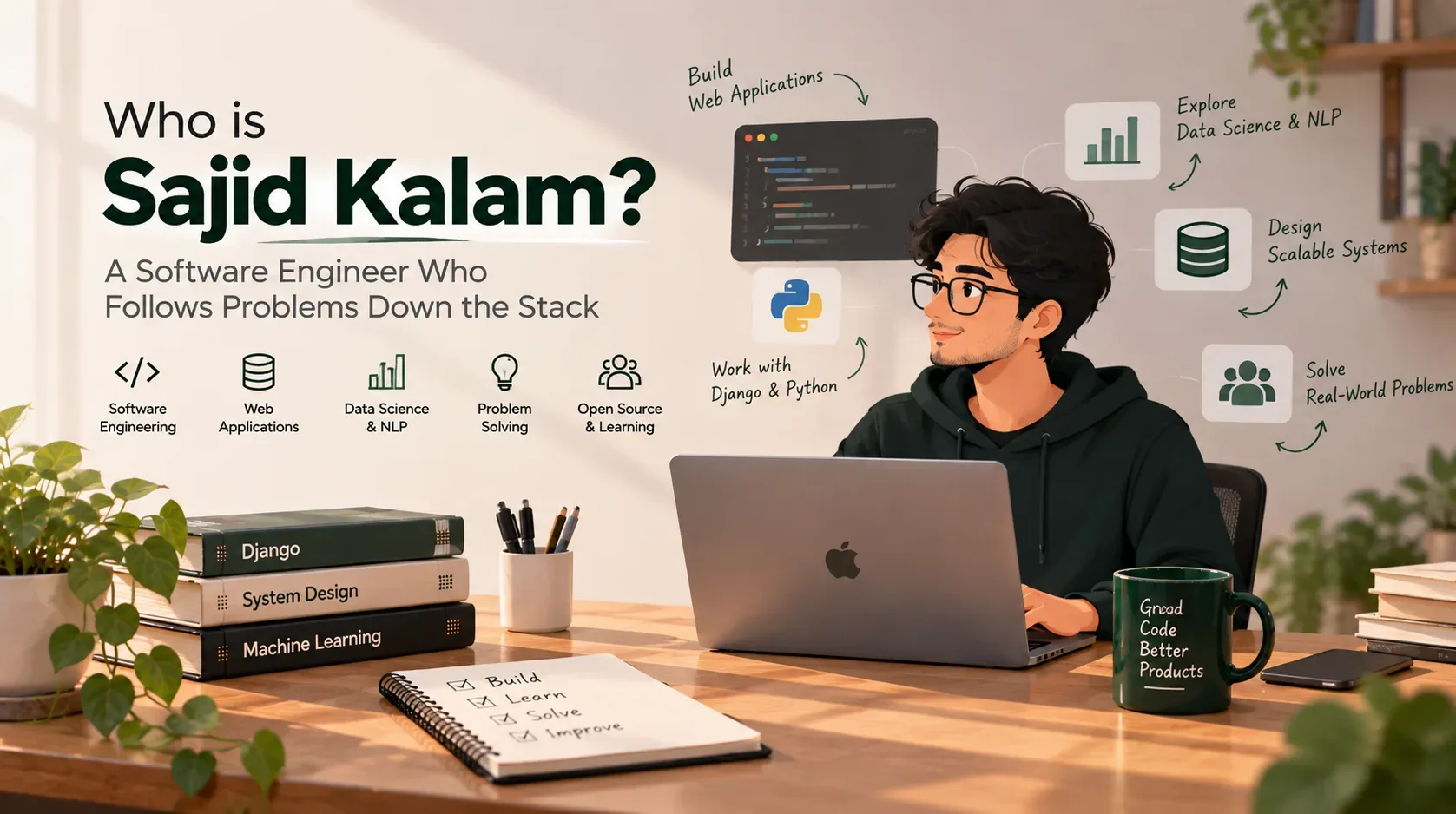
Who Is Sajid Kalam? A Software Engineer Who Follows Problems Down the Stack
I’m Sajid Kalam, a software engineer based in Siliguri, West Bengal, India. I build and maintain web applications with a focus on Python, Django, REST APIs, databases, and the systems that keep software running after launch.
The simplest way to describe how I work is this: I follow problems all the way down the stack.
I started with frontend development, but the work rarely stayed confined to what appeared on the screen. A form that behaved incorrectly could lead to a validation issue. A confusing workflow could point to a data-model problem. An API response could expose a permission gap. And a feature that worked locally still had to survive deployment and real-world use.
Over time, my work expanded into backend engineering, database design, API development, access control, deployment, and production support. Today, I’m an Associate Engineer at Corunit Media Corp, where I contribute to a production Electronic Medical Record (EMR) and patient intake platform. I’ve also planned, built, and deployed a B2B customer portal end to end.
This page brings together my background, the projects that have shaped my work, the technologies I use, and the engineering principles I try to follow.
What does Sajid Kalam do?
I work across backend and full-stack web development, with a particular interest in practical business software: applications that help people manage information, complete workflows, and make day-to-day work more reliable.
My work commonly involves:
- Backend engineering: building application logic with Python, Django, and Django REST Framework.
- APIs and data: designing REST endpoints, working with relational data models, and supporting data imports and migrations.
- Access and security: implementing authentication, role-based access control, and audit logging.
- Frontend integration: connecting backend functionality to interfaces built with JavaScript, HTML, CSS, and related tools.
- Deployment and maintenance: working with AWS infrastructure, Nginx, Gunicorn, environment configuration, and production debugging.
- Applied machine learning: building and evaluating text-classification models using conventional machine-learning techniques.
I’m interested in how these layers fit together. A feature is not finished just because its interface looks right or its endpoint returns a response. It also needs to respect permissions, handle unexpected input, preserve data integrity, and behave predictably in the environment where people use it.
My current work at Corunit Media Corp
I work as an Associate Engineer and full-stack web developer at Corunit Media Corp. My work includes contributing to a production EMR and patient intake platform built with Django.
Healthcare software has interconnected workflows. Patient intake connects to records; clinical documentation connects to appointments; billing and administration depend on the information captured earlier. A change in one part of the system can affect several others.
My responsibilities have grown from frontend work into a broader set of engineering tasks, including:
- Developing and improving patient intake workflows.
- Working on clinical documentation features, including SOAP notes.
- Contributing to appointment scheduling, billing, superbill, authorization, ticketing, and administrative workflows.
- Developing REST APIs with Django REST Framework.
- Working with database design, data validation, imports, and migrations.
- Implementing authentication, role-based access control, and audit logging.
- Investigating client-reported bugs and helping maintain production software.
- Supporting deployment and operations involving AWS, Nginx, Gunicorn, backups, SSL, DNS, and storage.
Because the platform handles sensitive information, correctness and careful access control matter alongside usability. The engineering work needs to support the workflow without exposing information to the wrong users or making routine tasks harder than they need to be.
The public case study describes the system and my role at a general level. It does not publish private patient information, confidential code, or non-public implementation details.
Read more: EMR & Patient Intake Platform
A project I took from requirements to deployment
One of the clearest examples of my end-to-end work is the Lanexis Customer Portal, a B2B platform built to bring information and operational workflows that had been spread across internal spreadsheets into a more connected system.
The project involved more than writing backend code. I worked on understanding requirements, planning the application, designing its main components, developing backend functionality, connecting integrations, building the mobile experience, and deploying the system.
The technology stack included:
- Django and Django REST Framework for backend functionality.
- React Native and Expo for the mobile application.
- PostgreSQL for relational data.
- Google Sheets API integration.
- AWS infrastructure, including EC2, RDS, and S3.
- Nginx and Gunicorn for application deployment.
The project reinforced an important part of software delivery: requirements, interfaces, data, integrations, deployment, and client communication all influence one another. A solution has to fit the way a business operates, not just the way a developer imagines the application should work.
Read more: Lanexis Customer Portal
My foundation in data science and NLP
Before moving into my current engineering role, I completed a data science internship at Personifwy. During that period, I built and evaluated two supervised natural language processing (NLP) classification projects.
SMS spam classification
I built a classifier to distinguish spam messages from legitimate SMS messages. The project used TF-IDF to represent text as numerical features and a Support Vector Machine (SVM) for classification. I also used GridSearchCV for hyperparameter tuning.
The project’s evaluation data produced a reported accuracy of 98%. That figure describes the evaluation for that project; it should not be interpreted as a guarantee of performance on every dataset or in real-world deployment.
Hate-speech detection
For the second project, I built a Logistic Regression classifier using preprocessed text. I addressed class imbalance with SMOTE, a technique for generating synthetic examples of minority classes during training.
The project’s evaluation data produced a reported accuracy of 92%. As with any classification model, accuracy alone does not tell the whole story. Class balance, false positives, false negatives, and the quality of the evaluation data also matter.
These projects gave me practical experience with text preprocessing, feature extraction, model evaluation, class imbalance, and the limits of machine-learning metrics. They remain part of my broader technical foundation, alongside backend and full-stack engineering.
Education and learning
My formal education includes a Bachelor of Computer Applications (BCA) from the University of North Bengal and a Master of Computer Applications (MCA) from Siliguri Institute of Technology.
- MCA: Siliguri Institute of Technology, 2024–2026; CGPA 8.63/10.
- BCA: University of North Bengal, 2021–2024; CGPA 9.31/10.
I see education as a foundation rather than a finish line. Software engineering keeps presenting new constraints: unfamiliar codebases, evolving libraries, infrastructure choices, data edge cases, and requirements that become clearer only after people start using a feature.
I continue to deepen my understanding of backend and platform engineering, cloud infrastructure, and AI-enabled applications. I also use small projects and experiments to explore ideas beyond my day-to-day work.
Projects beyond my professional role
My portfolio includes a mix of production work, personal projects, academic work, and experiments. Each has taught me something different about how software is designed and built.
DailyExplainers
DailyExplainers is a content platform built with Django, Python, and Tailwind CSS. It is designed around long-form explainers, Markdown-based authoring, scheduled publishing, search, and SEO-friendly content structure.
Chess for Two
Chess for Two is a browser-based, two-player chess game. It uses JavaScript, HTML, CSS, and PeerJS to connect players through WebRTC, without relying on a traditional backend server or database for gameplay.
Quiz Hub
Quiz Hub is an AI-assisted student portal built with Django. It supports quiz creation and participation, with role-based access for students, teachers, and administrators.
Rail Madad AI Complaint Management
As part of Smart India Hackathon 2024, I worked on a concept for AI-assisted complaint management for Rail Madad. The idea explored processing text, image, and video complaints, including multilingual input, to help classify and organize submissions.
Private client systems
Some client work cannot be published in full because it involves private repositories or confidentiality commitments. I can discuss the general problem, my role, and the engineering approach where permitted, but I do not share confidential code, client details, or private screenshots.
You can explore the public work on the Projects page.
The engineering principles I try to follow
Tools and frameworks matter, but they do not replace the decisions that make a system dependable. A few principles guide how I approach software.
1. Understand the workflow before the code
Before deciding what a model, endpoint, or screen should look like, I want to understand who will use it and what they are trying to accomplish.
A clinic administrator, clinician, and patient may interact with related information in very different ways. The system needs to reflect those differences clearly.
2. Put important rules on the server
Frontend validation helps people use an application, but it cannot be the only line of defence. Permissions, data validation, and other critical rules need to be enforced on the server so that they apply regardless of which screen or API request is used.
3. Make changes traceable
Audit trails, careful migrations, clear logs, and controlled changes help teams understand what happened when something goes wrong. Traceability makes systems easier to investigate and maintain.
4. Treat deployment as part of the work
A feature that works on a development machine still needs configuration, deployment, monitoring, and debugging in its target environment. Production support is not separate from software engineering; it is part of delivering software people can depend on.
5. Stay with the problem until the cause is understood
A visible bug is not always the underlying bug. A broken workflow may involve the interface, API, permissions, data model, external integration, or deployment configuration. I try to investigate the cause instead of stopping at a superficial workaround.
6. Keep learning in depth
I would rather understand a technical decision and its trade-offs than collect tools without knowing when they are appropriate. The goal is not to use the most complicated solution; it is to choose a solution that fits the problem and can be maintained.
Technologies I work with
My toolkit spans backend development, frontend integration, data, databases, and deployment.
| Area | Technologies and concepts |
|---|---|
| Backend | Python, Django, Django REST Framework |
| APIs and integration | REST API design, API documentation, third-party API integration |
| Frontend | HTML5, CSS, JavaScript, Bootstrap, Tailwind CSS |
| Mobile | React Native, Expo |
| Databases | PostgreSQL, MySQL, SQLite, relational data modelling, migrations, query optimization |
| Data and machine learning | pandas, NumPy, scikit-learn, NLTK, SVM, Logistic Regression, TF-IDF, SMOTE |
| Security and reliability | Authentication, authorization, role-based access control, audit logging, data validation |
| Deployment and operations | AWS EC2, RDS, S3, Nginx, Gunicorn, environment configuration, production debugging |
| Development workflow | Git, GitHub, background task scheduling |
This list reflects technologies I have used across different roles and projects. It should not be read as a claim that every tool was used in every project or that all tools are used at the same level in my current work.
What kind of problems do I want to work on?
I’m particularly interested in backend and full-stack engineering opportunities where software needs to do more than demonstrate a concept. I enjoy work involving real workflows, structured data, APIs, integrations, and the operational details that make an application dependable.
That might mean developing a backend service, improving an existing Django application, connecting a business workflow to an API, investigating a production issue, or taking a client project from an initial brief toward deployment.
I value clear requirements, thoughtful technical decisions, maintainable code, and communication that helps everyone understand what is happening and why. I also believe a useful engineering portfolio should show the problem, the role, the approach, and the trade-offs—not just a list of technologies.
Work with Sajid Kalam
If you’re a recruiter evaluating my experience, a founder planning a web application, or a team looking for a backend or full-stack collaborator, the best starting point is a clear conversation about the problem you need to solve.
You can explore my projects and case studies, review my professional experience, or get in touch.
A short message describing your team, project, current stack, or challenge is enough to begin.
Sajid Kalam
Software Engineer · Backend and Full-Stack Web Development
Siliguri, West Bengal, India
Website · Projects · Contact