
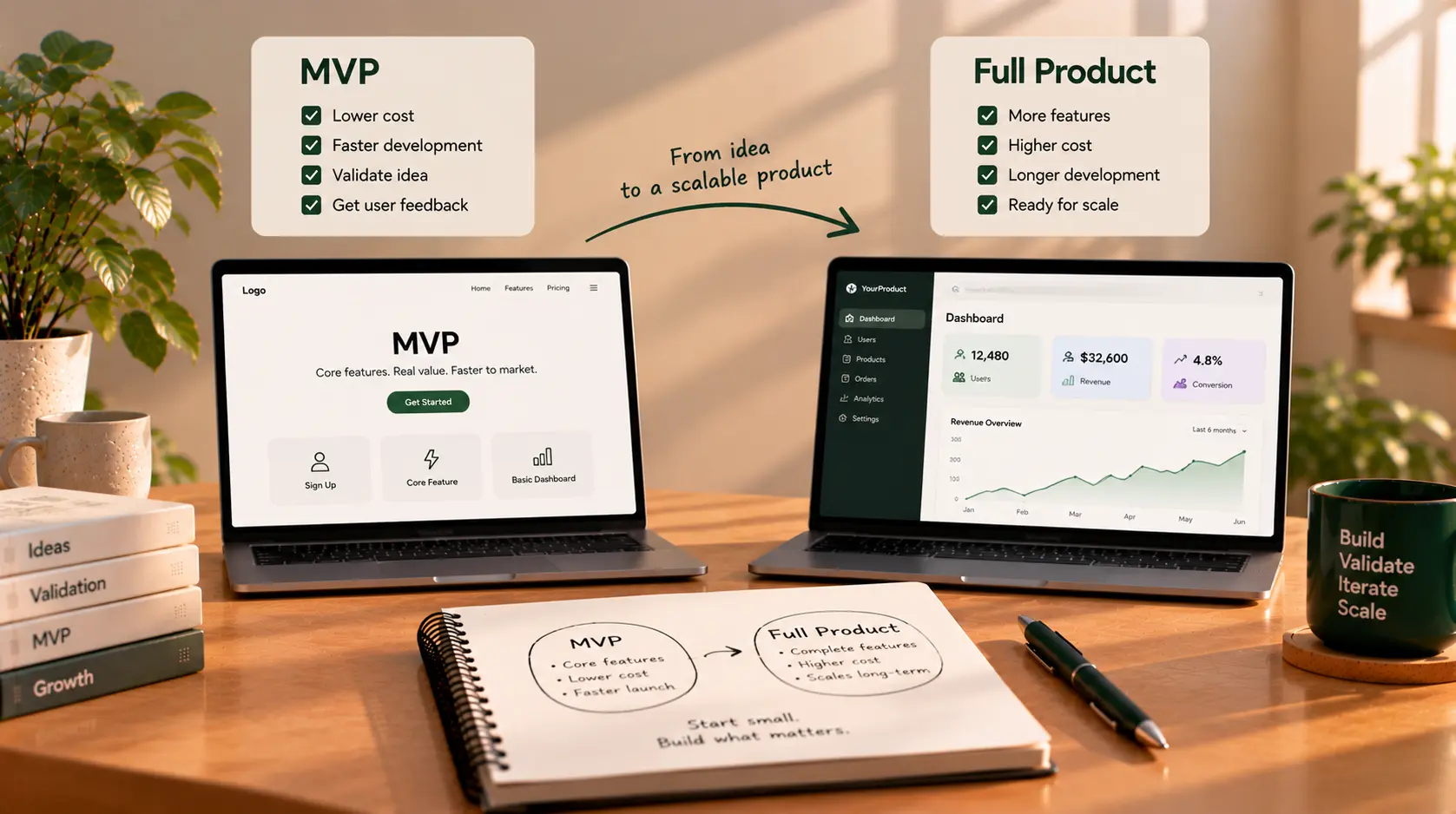
MVP vs Full Product: How Much to Build First
You have a product idea, a list of features, and a vision for what the software could become. You may want user accounts, a dashboard, notifications, payments, reports, integrations, an admin panel, and a mobile app. The challenge is deciding how much of that vision should be built before the product reaches its first real users.
Build too little, and people may not be able to experience the value of your idea. Build too much, and you may spend months and a significant part of your budget developing features before you know whether customers need them.
This is the central decision behind MVP development: choosing the smallest useful version of a product that can test your most important assumptions with real users.
An MVP is not simply a cheap or unfinished version of a full product. It should complete a meaningful task, work reliably enough for its intended use, and help you learn what to build next. Microsoft's guidance on minimum viable products similarly emphasises delivering value, gathering feedback, and improving the product based on what you learn (Microsoft Learn: Minimal Viable Product Strategy).
This guide explains the difference between an MVP and a full product, how to decide what belongs in the first release, and how to avoid spending your budget on features that do not yet need to exist.
What Is an MVP?
MVP stands for minimum viable product. It is an early, usable version of a product designed to deliver its core value and test important assumptions with real users.
A good MVP focuses on one primary problem and a clear path through the product. It may have fewer features than the long-term vision, but the included journey should be coherent and functional.
For example, imagine you want to build an appointment-booking platform for independent wellness clinics. Your long-term roadmap may include:
- Online appointment booking
- Staff calendars
- Automated reminders
- Patient or customer profiles
- Online payments
- Subscription plans
- Reports and analytics
- Multiple clinic locations
- Mobile apps
- Marketing automation
Your first release may only need clinic setup, service availability, appointment booking, and a way for staff to manage bookings. If the main assumption is that clinics and customers will use your booking workflow, those features may be enough to test it.
The exact scope depends on the product and its risks. A product handling sensitive information or financial transactions may require additional security, privacy, operational, and compliance work before it can be used with real customers. “Minimum” should never mean ignoring the requirements needed to operate safely.
MVP vs Full Product: What's the Difference?
An MVP and a full product serve different purposes. The MVP is designed to validate the core value and reduce uncertainty; the fuller product supports a broader range of user needs and more mature operations.
| Area | MVP | Full product |
|---|---|---|
| Primary goal | Test the core problem and solution | Serve a wider set of needs and use cases |
| Feature scope | Small, focused, end-to-end workflow | Broader feature set based on validated needs |
| Target users | A defined early audience | Wider or more varied customer segments |
| Integrations | Only those essential to the core workflow | Additional integrations where justified |
| Reporting | Basic metrics needed to learn | More detailed operational and business reporting |
| Automation | Essential automation, with safe manual steps where practical | More extensive automation as volume and needs grow |
| Design | Clear, usable, and consistent | More refined and comprehensive across more scenarios |
| Success measures | Core task completion, adoption, feedback, and early demand | Retention, revenue, efficiency, reliability, and growth |
| Next step | Learn, refine, continue, or change direction | Improve, expand, and operate the product sustainably |
A full product is not necessarily a product with every imaginable feature. It is a product mature enough to meet its defined business and customer requirements. A product may remain intentionally focused even after it has grown beyond its MVP.
Why Startups Often Build Too Much Too Early
Founders usually have good reasons for wanting more features. They may want to impress investors, compete with established products, meet requests from potential customers, or avoid paying for development twice.
But every feature has a cost beyond the initial build. It may introduce more screens, business rules, permissions, data structures, testing, documentation, support, and future maintenance.
Building too much before validating demand can create several problems:
1. You delay learning from real users
If you spend a long time building a large feature set, you may not discover whether the core idea solves a meaningful problem until late in the project.
2. Your budget is spread across uncertain features
Money spent on a feature that users do not need is money you cannot use to improve the workflow that actually matters.
3. Complexity makes changes more expensive
Features often interact. A new role, integration, or billing rule can affect existing workflows and increase testing requirements.
4. You may mistake feature quantity for value
A product with twenty features is not automatically more useful than one with five. Users care about whether it solves their problem reliably and conveniently.
5. You make assumptions that could have been tested earlier
A founder may assume customers want a mobile app, advanced analytics, or complex automation. A focused release can reveal which needs are urgent and which can wait.
The point is not to avoid planning for the future. It is to avoid paying the full cost of unvalidated assumptions before you have evidence.
How to Decide What Belongs in the MVP
A practical way to scope an MVP is to start with the customer outcome, map the shortest complete journey that delivers it, and then include the supporting features needed to make that journey usable and safe.
Step 1: Define one target user and one problem
Be specific about who the product serves and what problem it solves.
Instead of “a platform for businesses,” try: “A booking tool that helps independent clinics accept appointments online without manually coordinating every request.”
A narrower problem makes it easier to decide which features are essential.
Step 2: Identify the core user journey
Describe the actions a user must take to get the product's main benefit. For a booking product, that journey might be:
- A clinic creates its profile and services.
- The clinic defines available appointment times.
- A customer selects a service and available time.
- The booking is saved and confirmation is shown.
- Staff can view and manage the appointment.
If the product cannot complete its core journey, it is probably too early to add secondary features.
Step 3: List the assumptions that could make the idea fail
Ask what you need to learn before committing to the full roadmap:
- Do customers have this problem often enough to seek a solution?
- Will they use the proposed workflow?
- Will the buyer pay for it?
- Can the product deliver the promised outcome reliably?
- Can the business acquire customers at a sustainable cost?
- Are there operational, regulatory, or integration constraints?
Prioritise assumptions by how uncertain they are and how much damage they could cause if they turn out to be wrong. The MVP should help test the most important ones, rather than merely demonstrate that the software can be built.
Step 4: Separate essential features from useful extras
For each proposed feature, ask:
- Is it required for the core journey to work?
- Does it reduce a meaningful risk?
- Is it necessary for trust, privacy, security, or safe operation?
- Does it help test a key business assumption?
- Can it reasonably wait until there is evidence that users need it?
If a feature does not support the core outcome, a critical requirement, or a high-priority learning goal, it may belong in a later release.
Step 5: Define what success looks like before launch
Choose a small number of measures that connect directly to the assumption you want to test.
Depending on the product, these could include:
- The percentage of users who complete the main task
- Time taken to reach the product's core value
- Repeat usage over a defined period
- Number of qualified users willing to pay
- Conversion from trial to paid use
- Error rates or failed transactions
- Qualitative feedback from observed user sessions
Set a review date and decide what evidence would justify expanding the product, changing the approach, or stopping the experiment. This prevents the team from treating a launch itself as proof of success.
What Should You Build First?
The exact feature set varies, but most MVPs need more than a collection of screens. They need a complete core journey and enough supporting functionality to use it responsibly.
| Feature area | Usually needed in an MVP? | How to decide |
|---|---|---|
| Core workflow | Yes | The main task must work from beginning to end |
| Basic user access | Often | Include the account model and access controls the workflow requires |
| Data storage and validation | Yes, where data is used | Data must be handled consistently and safely |
| Essential permissions | Yes | Users should only access authorised information and actions |
| Error handling | Yes | Users need understandable feedback when something fails |
| Basic analytics or event tracking | Usually useful | Measure whether users complete the core task |
| Admin tools | Depends | Include the minimum operations staff need to support users |
| Payments | Depends | Essential if testing paid transactions; otherwise validate the model another way where practical |
| Notifications | Depends | Include if the workflow depends on timely communication |
| Advanced reports | Often later | Start with metrics needed for decisions and validation |
| Multiple user roles | Depends | Build the roles required by the first target users |
| Complex integrations | Often later | Prioritise integrations that are essential to the core value |
| Mobile apps | Not automatically | A responsive web experience may be enough to test the idea |
| AI features or advanced automation | Only if central to the value | Do not add them just because they are available |
| Multi-region or enterprise features | Usually later | Include early only when the target market requires them |
This table is a starting point, not a universal recipe. A payment product, a healthcare system, and an internal workflow tool have different minimum requirements. The important distinction is between features that are optional for the experiment and controls that are necessary for the product to function safely.
What You Should Not Cut Just to Save Money
A smaller scope should reduce unnecessary complexity, not undermine the product's basic reliability.
Be cautious about cutting:
Security and access control. If real users or sensitive information are involved, implement appropriate authentication, permissions, secure configuration, and data protection from the start.
Data integrity. Validation, sensible constraints, and safe handling of failed operations help prevent corrupted records and inconsistent results.
Basic error handling. Users need to know whether an action succeeded, failed, or needs to be retried. Silent failures can undermine trust.
Testing of critical workflows. The main user journey should be tested before release, including important failure cases.
Deployment and recovery basics. Plan how the product will be deployed, monitored, backed up, and restored where applicable.
A way to learn from usage. If you cannot observe whether users complete the core task or understand why they leave, the MVP may not answer the question it was built to test.
These foundations do not require an enterprise-scale architecture. They require deliberate decisions that fit the product's risk, stage, and intended audience.
MVP Does Not Mean Poor Quality
One common mistake is treating an MVP as permission to launch a broken or confusing product. A useful MVP can be limited in scope while still being dependable within that scope.
For example, the first version of a booking system may support one location and one type of appointment. It does not need multi-location scheduling, complex staff commissions, or advanced reporting yet. But it should save a booking correctly, show the right availability, prevent invalid submissions, and give users clear confirmation.
The distinction is simple:
- Limited scope: Some features are intentionally postponed.
- Poor quality: Included features do not work reliably or create avoidable risk.
A focused product should deliver its promised outcome well, even if it does fewer things.
How Much Should You Budget for an MVP?
There is no reliable single price for every MVP. Cost depends on the complexity of the core workflow, the number of user roles, design needs, integrations, data migration, security requirements, testing, and deployment.
A useful budget begins with a defined scope rather than a long feature wishlist. Ask a developer to estimate:
- Discovery and requirements clarification
- User-flow design and interface work
- Backend and frontend development
- Database and integration work
- Testing and bug fixing
- Deployment and initial monitoring
- Documentation and handover
- Post-launch support and iteration
Ask what is included in the estimate and what is excluded. Clarify whether third-party service fees, hosting, ongoing maintenance, and future changes are separate costs.
It is also sensible to reserve some budget for issues discovered during testing and early usage. The goal is not to predict every detail perfectly; it is to make the first release small enough that changes remain manageable.
For a related discussion of planning and cost drivers, see What Changes the Cost of a Custom Web Application?.
A Practical Example: MVP vs Full Product for a Service Marketplace
Imagine you want to create a marketplace where customers can discover service providers and book appointments.
A possible MVP
- Provider profile and service details
- Search or a simple way to browse available providers
- Available time slots
- Booking submission and confirmation
- Basic provider booking management
- Essential account access and permissions
- A way for the operator to resolve basic booking issues
- Tracking for booking completion and failures
This allows the team to test whether customers can find a suitable provider and complete a booking, and whether providers can manage those bookings.
Features that might wait
- Native iOS and Android apps
- Loyalty points and referral programmes
- Advanced recommendation algorithms
- Multiple subscription tiers
- Complex promotional campaigns
- Advanced analytics dashboards
- Multi-region operations
- Extensive third-party integrations
Some of these may become essential later. If the marketplace's main differentiator is a recommendation algorithm, or the target users primarily book through mobile apps, the initial scope should change accordingly. The list is a way to reason about priorities, not a fixed feature prescription.
The key is to test the riskiest part of the business model with a coherent experience before investing in every possible capability.
How to Move From MVP to a Full Product
Launching the MVP is the beginning of a learning process, not the end of product planning. Once real users start interacting with the software, use the evidence to decide what deserves investment.
1. Review behavior, not just opinions
Feedback matters, but observed behavior can reveal where users struggle or what they value most. Look at task completion, repeat usage, support requests, and drop-off points alongside interviews and surveys.
2. Fix friction in the core workflow
If users cannot complete the main task reliably, improving that experience may be more valuable than adding a new feature.
3. Prioritise repeated, high-impact requests
One customer's request may be specific to their workflow. Requests that recur across the target audience—and support the product's strategy—are stronger candidates for the roadmap.
4. Improve reliability as usage grows
Monitor errors, performance, data quality, and support needs. Technical improvements should be driven by actual risks and expected growth, not by a desire to adopt the most complex architecture.
5. Expand in deliberate stages
Add features that support validated needs. After each meaningful release, review the results and adjust the roadmap.
Microsoft's guidance on MVP strategy emphasises iterative feedback and changes based on what teams learn from using the product (Microsoft Learn).
A Checklist Before You Approve the MVP Scope
Before development starts, make sure you can answer these questions:
- Who is the first target user?
- What specific problem are we solving?
- What is the main outcome the user should achieve?
- What is the shortest complete workflow that delivers that outcome?
- Which assumptions must be tested before expanding the product?
- Which features are essential, and which can wait?
- What security, privacy, and operational requirements apply?
- How will we know whether the MVP is working?
- What is included in the development estimate?
- What is explicitly outside the first release?
- Who will support the product after launch?
- When will we review the evidence and decide what to build next?
If these questions remain unanswered, more feature planning may not solve the real problem. Spend time clarifying the outcome and the assumptions before committing to implementation.
Final Thoughts
The choice between an MVP and a full product is not about whether you want a small product or a large one. It is about how much you need to build to deliver real value, test your assumptions, and make the next decision with better evidence.
Start with one target user, one meaningful problem, and a core journey that works end to end. Include the security, data handling, testing, and operational foundations the product needs. Postpone features that do not support the first release's purpose, then use real user behavior to decide what comes next.
If you're planning a startup product and need help defining a realistic first release, get in touch to discuss the core workflow, technical scope, and development approach before committing to a full build.