
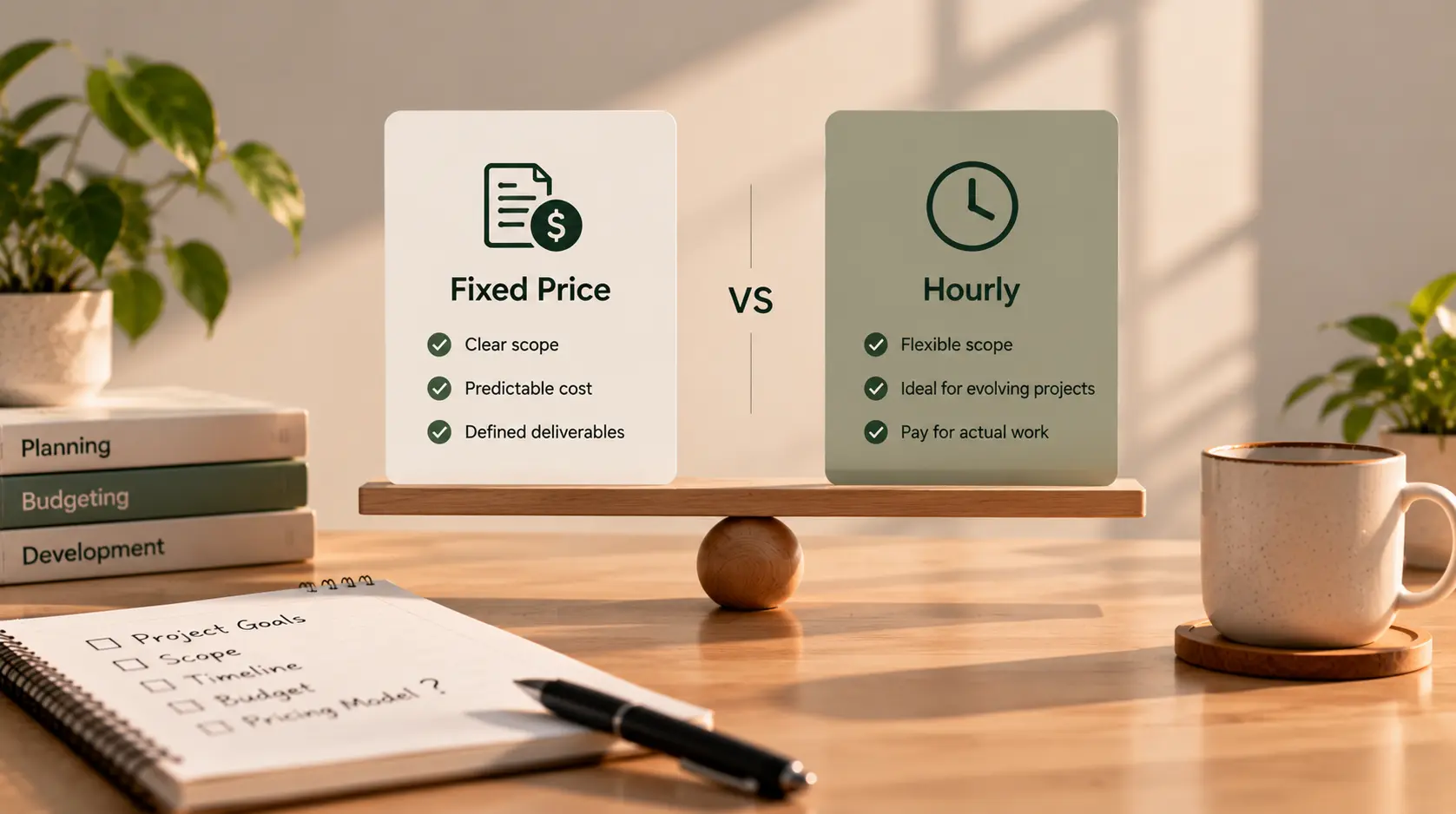
Fixed Price vs Hourly Software Development: How to Choose
When you hire a freelance developer to build a website or web application, one of the first questions is how you should pay: agree on a fixed price for the project or pay for the hours worked?
Both models can work well. The right choice depends on how clearly you can define the project, how likely the requirements are to change, how much budget certainty you need, and how closely you can manage the work.
A fixed quote can make budgeting easier, but it does not mean every future request is included. Hourly billing gives you more room to change direction, but the final cost can be harder to predict without clear limits and regular updates.
This guide explains the differences between fixed-price and hourly software development, the trade-offs of each model, and how to choose an arrangement that fits your project.
Fixed price vs. hourly: the key difference
With a fixed-price agreement, you and the developer agree on a price for a defined set of deliverables. The price applies to the work described in the agreed scope. If you add features or change requirements, the extra work may need a separate estimate and approval.
With an hourly agreement, you pay an agreed rate for the time the developer spends on the work. You may start with an estimate, but the final bill depends on the hours used unless the agreement includes a cap or another spending limit.
The core difference is not simply how the invoice looks. It is how each model handles uncertainty, changes, and work that takes longer than expected.
| Factor | Fixed price | Hourly |
|---|---|---|
| How you pay | Agreed price for defined deliverables | Rate multiplied by approved hours |
| Budget predictability | Higher for the agreed scope | Depends on hours, estimates, and limits |
| Flexibility | Changes usually need review and approval | Easier to adjust tasks and priorities |
| Planning needed upfront | More detailed scope and acceptance criteria | Can begin with a smaller initial scope |
| Best fit | Clear, bounded work | Evolving or investigative work |
| Main risk | Disputes over what is included | Cost can grow if work expands |
| Oversight | Review milestones and deliverables | Review progress, time, and budget regularly |
Neither model guarantees a successful project. A vague fixed-price quote can cause disputes, while an hourly engagement without priorities or spending controls can drift. A clear agreement matters whichever model you choose.
When fixed-price development makes sense
Fixed pricing is usually a good fit when you can describe what needs to be delivered before development begins.
For example, you may need a business website with a known set of pages, a contact form, a content management system, and a defined launch process. Or you may want to add one clearly specified feature to an existing application. If the functionality, dependencies, and responsibilities are understood, a developer can estimate the work with more confidence.
Fixed price can be especially useful when:
- Your budget needs to be approved before work starts.
- The essential features and deliverables are already agreed.
- The project has a clear start and end point.
- The integrations and technical requirements are reasonably understood.
- You want to evaluate progress against agreed milestones.
- You can make decisions and provide content or access on schedule.
Benefits of fixed-price projects
You know the agreed cost upfront. This makes it easier to plan the budget for the work included in the contract.
Deliverables can be easier to evaluate. When the scope and acceptance criteria are clear, both sides can check whether the agreed work has been completed.
You spend less time reviewing every hour. You still need updates and reviews, but payment is tied to the agreed deliverables or milestones rather than each hour worked.
The developer takes on some estimation risk. If the agreed work takes longer than expected, the developer generally cannot simply increase the price for the same scope. The actual terms of the contract still matter.
The limitations of fixed pricing
Fixed price is not the same as unlimited work for one amount. If the project grows, the original quote may no longer cover what you want.
Common sources of friction include:
- Adding new features after development has started.
- Changing a design or workflow after approval.
- Discovering undocumented problems in an existing system.
- Delays caused by missing content, access, or decisions.
- Unclear rules for revisions, testing, and launch support.
A developer may also include a contingency in the quote to account for uncertainty. That is not necessarily a problem: the developer is committing to a defined outcome despite some delivery risk. But it means a fixed-price project is not automatically cheaper than hourly work.
Before agreeing to a fixed price, make sure the proposal lists what is included, what is excluded, how changes are priced, and how completion will be accepted.
When hourly development makes sense
Hourly billing is useful when you cannot confidently define all the work upfront or expect priorities to change as you learn more.
Imagine you have inherited a web application built by another developer. Before anyone can estimate the repairs, they may need to inspect the code, reproduce bugs, review integrations, and identify the cause of failures. A fixed quote at this stage may rely on guesses. A short, time-boxed investigation can provide the information needed to decide what to do next.
Hourly work may be a better fit when:
- You are investigating bugs or an unfamiliar codebase.
- The requirements are still being discovered or tested.
- You expect to change priorities during development.
- You need ongoing improvements after launch.
- You want to start with a small task before defining a larger project.
- You have someone who can help prioritize work and review time and progress.
Benefits of hourly projects
You can adjust priorities more easily. If user feedback changes the direction of the product, the next task can often be updated without renegotiating the entire project.
You pay for the time used. You can see how much time was spent, provided the developer maintains useful time records and reports.
It can suit discovery and troubleshooting. Some technical work cannot be estimated responsibly until the developer has investigated the problem.
You can begin with a limited engagement. A small initial budget or time cap can help you evaluate the working relationship before expanding the work.
The limitations of hourly billing
The final cost can be uncertain, especially when requirements change or new issues are discovered. An initial estimate is useful, but it is not necessarily a guaranteed maximum.
To reduce the risk of overspending, agree on:
- The hourly rate and how time is recorded.
- The initial estimate or budget range.
- A weekly or milestone-based progress update.
- The tasks that have priority.
- A spending cap or approval threshold.
- A rule that the developer must pause and seek approval before exceeding the agreed limit.
Hourly billing should not mean an open-ended commitment. You should be able to see what has been completed, what remains, how much budget has been used, and what the next decision is.
Which model is cheaper?
There is no universal answer. The lowest hourly rate does not always produce the lowest total cost, and a fixed quote is not always the least expensive option.
Consider two simplified scenarios.
Scenario A: a clearly defined website
You have agreed on the pages, features, content responsibilities, design direction, and launch requirements. The developer has enough information to estimate the work.
A fixed-price agreement may suit this project because both sides can agree on a clear deliverable. An hourly arrangement could also work, but you would still need to monitor the total hours and budget.
Scenario B: an application with unknown problems
Your existing application has intermittent errors, incomplete documentation, and integrations that have not been reviewed. It is not yet clear what needs to be repaired.
A fixed quote for all repairs may be unreliable before an investigation. A limited hourly diagnostic stage could identify the issues and produce a more realistic estimate for the next stage.
These examples show why you should compare the total arrangement, not just the headline price. For fixed price, review the scope, exclusions, change process, and acceptance criteria. For hourly, review the estimate, reporting, prioritization, and spending controls.
The hybrid model: use each approach where it fits
You do not have to use one pricing model for every stage of a project. A hybrid arrangement can be more realistic when some parts are predictable and others are uncertain.
One common approach is:
- Discovery or audit: Pay for a limited investigation to clarify the requirements, risks, and technical approach.
- Defined build: Agree on a fixed price for a clearly described phase or set of deliverables.
- Ongoing improvements: Use hourly billing or a capped retainer for smaller changes, support, and future features.
For example, you might start with a paid audit of an existing Django application, then agree on a fixed price for a specific set of improvements. After launch, new features could be handled through hourly work with a monthly spending cap.
A hybrid model is not automatically better. Each stage still needs a clear goal, budget, output, and decision about what happens next. Its advantage is that the payment model can reflect how much is known at each point.
How to protect your budget with either model
The pricing model is only one part of the agreement. These practices can reduce misunderstandings whichever option you choose.
1. Write a useful project brief
Describe the business problem, intended users, key features, integrations, constraints, and desired outcome. Separate must-have features from items that can wait.
If you need help preparing one, read the guide to writing a project brief a developer can estimate.
2. Define what “done” means
List the deliverables and how they will be reviewed. For a website, this could include agreed page types, responsive behaviour, forms, integrations, testing, and deployment. For an application, it might include specific workflows, permissions, and documented setup steps.
Avoid relying on a phrase such as “complete website” without defining what it means for your project.
3. Agree on how changes are handled
Decide what counts as a change to the agreed scope. The developer should explain the impact on cost and timing before doing additional work, and you should approve the change in writing.
4. Break larger projects into milestones
For a large project, use stages that produce reviewable outputs. Milestones give you opportunities to check progress and make decisions before committing the full remaining budget.
5. Ask for regular, understandable updates
Agree on a reasonable update schedule. Ask what was completed, what comes next, what risks have appeared, and how much budget remains. For hourly work, include hours used and the estimate for the next stage.
6. Clarify ownership and handover
Confirm who will control the code repository, domain, hosting, and relevant service accounts. Document the source-code ownership and licensing terms, as well as what documentation and access you will receive at handover.
7. Separate defects from new features
Agree on how bugs in the delivered scope will be handled and how new requests will be estimated. Do not assume that every future change is included in a fixed price or that all fixes are automatically free under hourly billing. The written agreement should explain the arrangement.
Questions to ask a developer before agreeing to a pricing model
Use these questions during your proposal discussion:
- “What information do you need before you can estimate this work?”
- “What exactly is included in the quoted price or estimated hours?”
- “What assumptions or unknowns could change the cost?”
- “How will we handle new features or changes to requirements?”
- “For hourly work, how often will you report time and budget?”
- “Can we agree on a spending cap or approval threshold?”
- “What are the milestones and how will we review deliverables?”
- “What testing, deployment, documentation, and handover are included?”
- “Who owns the code and controls the project accounts?”
- “What happens if we pause or end the engagement early?”
A developer should be willing to discuss these points. Clear answers do not eliminate every risk, but they make expectations easier to manage.
A quick decision guide
| Your situation | Model to consider | Why |
|---|---|---|
| The scope and deliverables are clear | Fixed price | Easier to agree on a total cost for defined work |
| You need to investigate unknown bugs | Hourly with a time cap | The effort is uncertain until the system is reviewed |
| You are testing a new product idea | Hourly or a short discovery phase | Learning may change the requirements |
| You need ongoing improvements | Hourly or capped retainer | Priorities can change over time |
| The project is large but can be divided into clear stages | Hybrid | Each phase can use a model suited to its level of certainty |
| Your budget is limited and must not be exceeded | Fixed price or capped hourly | The agreement must clearly define the financial limit and what happens when it is reached |
Use this table as a starting point, not a rule. A well-managed hourly project can work with a clear scope, and a fixed-price project can still fail if the agreement is vague or the delivery process is poor.
Final recommendation
Choose a fixed price when the project can be described clearly, the essential requirements are stable, and you value a predictable cost for agreed deliverables.
Choose hourly billing when the work is investigative, the requirements are likely to evolve, or you need flexibility to change priorities. Put a budget limit, regular reporting, and approval rules in place so flexibility does not become uncontrolled spending.
Consider a hybrid model when the project begins with uncertainty but later stages can be defined more precisely.
Most importantly, do not choose based on the pricing label alone. Read the scope, ask how changes will be handled, agree on acceptance criteria, and make sure you understand what you will receive for the money. A clear agreement and a developer who communicates honestly matter more than whether the quote is fixed or hourly.
If you are planning a web project and want to discuss its requirements, you can use the site's contact page to get in touch.