
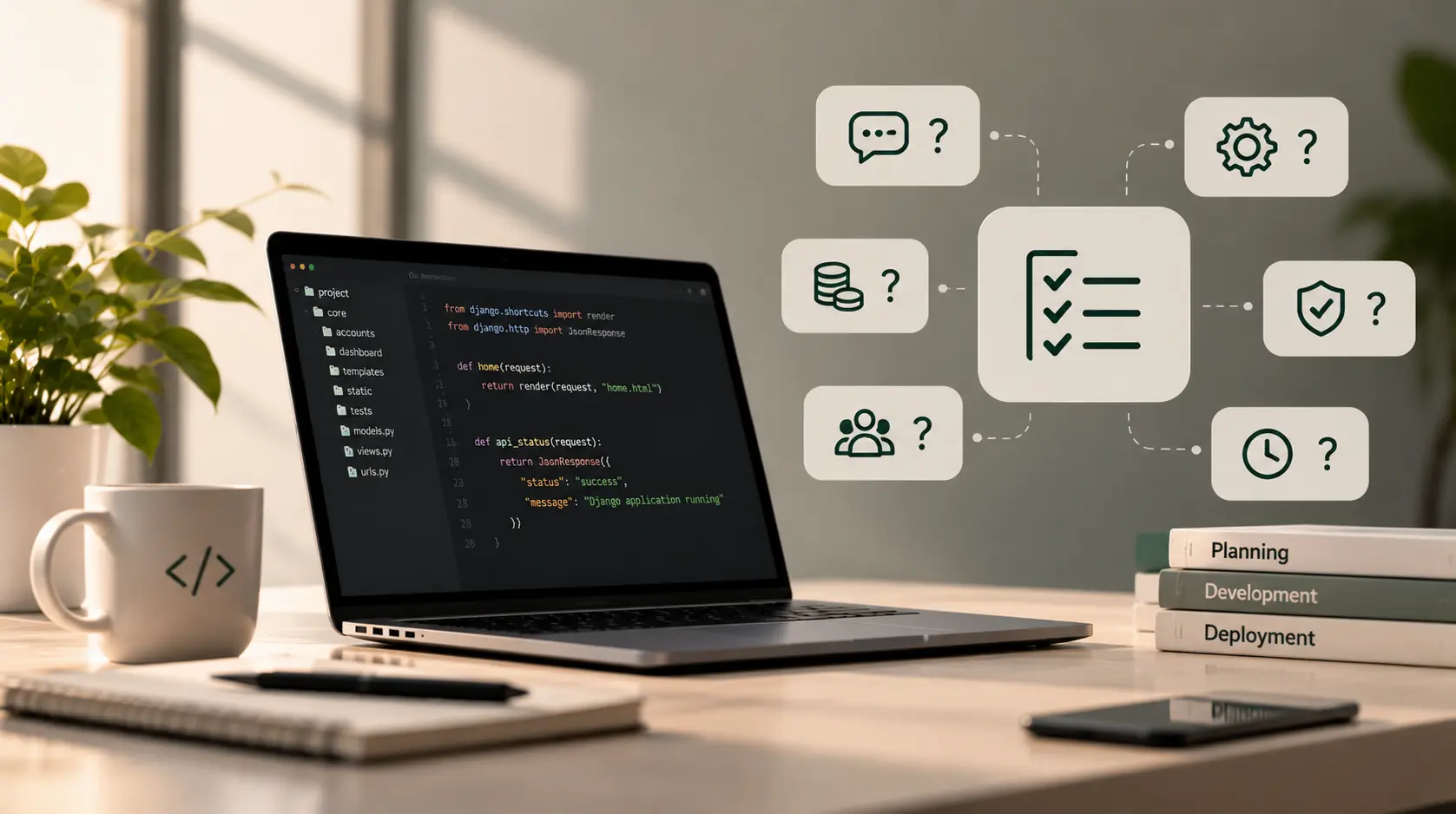
Introduction
Hiring a web developer is an important decision for a founder. The person or team you choose may influence how your product works, how easily it can grow, how much it costs to maintain, and how smoothly your project reaches launch.
A polished portfolio and an attractive quote are useful starting points, but they do not tell you everything you need to know. Before signing an agreement, you should understand what the developer will deliver, how the work will be managed, what you will be expected to provide, and what happens after the website or application goes live.
You do not need to be a technical expert to have this conversation. You need clear questions and answers you can understand.
This guide covers the questions to ask a web developer before committing to a project, from defining requirements and estimating costs to security, ownership, and handover. If you are still at the candidate-evaluation stage, our Django developer hiring checklist can help you assess technical experience before you compare proposals.
1. Questions About Relevant Experience
Start by understanding whether the developer has experience that is relevant to your project. You do not necessarily need someone who has built the exact same product, but they should be able to explain how their experience applies to your requirements.
What projects have you worked on that are similar to mine?
Ask for examples that demonstrate comparable functionality, complexity, or technical challenges. A business website, a customer portal, and a subscription-based SaaS platform can all be web projects, but they may require very different approaches.
Ask the developer to explain their role in each example. Did they build the backend, implement the interface, integrate external services, manage deployment, or coordinate the entire project?
What was your specific contribution to those projects?
A portfolio may show work completed by a team. Clarify which parts the developer personally handled and which were completed by other contributors.
This helps you understand the skills you are actually hiring rather than assuming that every portfolio feature was built by one person.
Can you explain a technical decision you made and why?
A developer should be able to describe the reasoning behind important decisions in plain language. For example, they might explain why they selected a particular database structure, used an API integration, or chose a specific deployment approach.
The goal is not to test whether the developer agrees with your preferred solution. It is to understand how they evaluate trade-offs and communicate technical choices.
You can also review Sajid Kalam's project case studies, which describe project context, responsibilities, technical approaches, and implementation considerations.
2. Questions About Requirements and Scope
Unclear requirements are a common source of disagreement. Before signing, make sure you and the developer have the same understanding of what is being built.
What do you understand the project needs to achieve?
Ask the developer to summarise the problem, intended users, and main outcomes. This is a useful way to discover misunderstandings before work begins.
If you are building a customer portal, for example, the project may involve different permissions for customers, staff, and administrators. If those roles are not discussed early, they can create significant changes later.
What is included in the agreed scope?
Ask for a written list of features and deliverables. Depending on the project, this might include:
- Page layouts and responsive behaviour.
- User registration, login, and password recovery.
- Admin dashboards and role-based permissions.
- Database design and data migration.
- API development and third-party integrations.
- Content entry and asset preparation.
- Testing, deployment, and documentation.
Not every project needs all these items. The important thing is to identify which ones apply and which are outside the agreement.
What is explicitly excluded?
This question is just as important as asking what is included. Clarify whether copywriting, branding, hosting, domain setup, paid integrations, data entry, ongoing SEO, or post-launch changes are part of the quote.
A clear list of exclusions makes it easier to compare proposals fairly.
How will changes to the requirements be handled?
Most projects evolve as the client sees early versions and learns more about what they need. Ask how new requests will be assessed, approved, scheduled, and priced.
A change process does not need to be complicated. It should simply prevent additional work from appearing without a shared understanding of its impact.
3. Questions About Timeline and Milestones
A launch date is useful only when it is supported by a realistic plan.
What is the estimated timeline, and what does it depend on?
Ask for an estimate that reflects the scope, complexity, integrations, and availability of the people involved. A responsible developer should be able to explain the assumptions behind the estimate rather than promising a date without understanding the work.
The timeline may also depend on how quickly you provide content, approve designs, supply credentials, or answer questions.
What are the key milestones?
For a larger project, milestones might include requirements and planning, design approval, core development, integrations, testing, deployment, and handover.
Ask what you will be able to review at each stage and what needs to be approved before the next stage begins.
What could delay the project?
Potential blockers may include unclear requirements, late content, third-party API limitations, migration issues, or unexpected problems in an existing codebase.
You are not looking for a guarantee that nothing will go wrong. You want to know whether the developer identifies risks early and communicates when plans need to change.
How will progress be reported?
Agree on a practical update schedule and a shared place to track tasks, decisions, and issues. For a small project, a simple weekly update may be enough. Larger projects may need more frequent communication.
4. Questions About Pricing and Payments
Before signing, make sure you understand not only the total quote but also how it was calculated and what could change it.
How was the estimate calculated?
Ask whether the proposal is fixed-price, hourly, milestone-based, or a combination. Each approach can work, but the right choice depends on how clearly the scope is defined.
A fixed-price agreement can be suitable when deliverables are clear. Hourly billing may be more practical for debugging, maintenance, or requirements that are likely to evolve.
What does the price include?
Confirm whether the quote includes design, development, testing, deployment, documentation, and handover. Ask about recurring expenses such as hosting, domain renewals, paid software, API usage, and maintenance.
Keep one-time development costs separate from ongoing operating costs so you can plan for both.
When are payments due?
Payment terms should be written down. For milestone-based work, each payment should correspond to a clearly described stage or deliverable. Confirm what needs to be completed or accepted before payment is due.
How are additional costs approved?
Ask how the developer will inform you if the project needs more time or money than expected. Agree that material changes should be explained and approved before additional charges are incurred.
Do not compare proposals by price alone. A lower quote may exclude testing, deployment, or other work that another proposal includes.
5. Questions About Technology and Architecture
You do not need to select the technology stack yourself, but you should understand the main choices and how they relate to your business goals.
Which technologies do you recommend, and why?
Ask the developer to explain the proposed frontend, backend, database, and hosting approach. The answer should relate to your actual requirements, not simply list popular technologies.
For example, some Django applications can use server-rendered templates, while others benefit from a separate frontend and API. More technologies do not automatically make an application better.
How will the application handle future changes?
Ask how the proposed structure will support new features, additional users, or changes in business workflows. No one can predict every future requirement, but maintainable code and sensible architecture can make change easier.
Which external services or integrations are required?
Identify payment providers, email services, analytics tools, CRMs, booking systems, or other services the application needs. Ask who will configure them, what access is required, and whether they introduce separate fees or usage limits.
What happens if a third-party service changes?
External services can change their APIs, pricing, or availability. Ask how important dependencies will be documented and what the plan is if an integration stops working or requires an update.
6. Questions About Security, Privacy, and Data
Security should be discussed before development begins, particularly if the application stores personal information, business records, payment-related data, or confidential documents.
How will users and permissions be managed?
Ask how the application will authenticate users and enforce permissions. If different users should have different access, clarify how those rules will be defined and tested.
For Django projects, it is useful to discuss server-side permission checks rather than relying only on what the interface displays.
How will sensitive data be protected?
Ask what data the application will collect, where it will be stored, who can access it, and how it will be protected. The appropriate safeguards depend on the data and the legal requirements that apply to your business.
Do not assume that using a particular framework automatically makes an application secure.
How will backups and recovery work?
Clarify whether backups are included, how often they are taken, who can access them, and how recovery would be tested. A backup is most useful when you know it can be restored.
How will security issues be handled after launch?
Ask who is responsible for dependency updates, vulnerability fixes, access reviews, and incident response. Confirm whether this work is included in a maintenance agreement or billed separately.
If the project involves regulated or highly sensitive information, obtain appropriate specialist advice on the applicable compliance obligations rather than relying solely on a developer's general assurance.
7. Questions About Testing and Quality Assurance
An application may appear to work during a demonstration and still have problems under different conditions. Testing should be part of the plan, not an afterthought.
What testing will be performed?
Ask whether the project includes manual testing, automated tests, integration testing, responsive checks, performance testing, or security checks. The appropriate mix depends on the application.
How will bugs be reported and prioritised?
Agree on how issues will be documented, how severity will be assessed, and how fixes will be tracked. Ask what happens if a problem is discovered just before launch.
Who approves the finished work?
Define acceptance criteria for important deliverables. For example, a feature may be considered complete when specified actions work, expected validation is applied, permissions are enforced, and agreed tests pass.
Clear acceptance criteria reduce the risk of disagreements about whether work is finished.
Will I be able to review the application before launch?
Ask when you can test a staging or preview version. Make sure there is time for feedback and agreed corrections before the application is made available to users.
8. Questions About Communication and Responsibilities
A good working relationship depends on clear responsibilities on both sides.
Who will be my main point of contact?
If you hire an agency, clarify who manages communication and who makes technical decisions. If you hire a freelancer, establish how to contact them and what response times you can reasonably expect.
What do you need from me to keep the project moving?
You may need to provide content, brand assets, user workflows, access to existing systems, or timely feedback. Ask what is required and when so that your own responsibilities are visible in the plan.
How will disagreements or changing priorities be handled?
Agree on how decisions will be documented and how scope or priority changes will be approved. Written records of important decisions help prevent misunderstandings.
What happens if the assigned developer becomes unavailable?
Ask about continuity, documentation, repository access, and handover. This is relevant whether you work with one freelancer or a larger team.
9. Questions About Code Ownership and Handover
Make sure you understand what you will own and receive when the project is complete.
Who owns the source code and deliverables?
Your agreement should clearly address ownership of the code, designs, documentation, and other project-specific deliverables, subject to any third-party licences and agreed terms.
Do not assume that payment automatically settles every intellectual-property question. Put the arrangement in writing and seek legal advice if the terms are unclear or the project is commercially significant.
Will I have access to the repository and hosting accounts?
Clarify how source code will be stored and who will have access during development. Where practical, business-critical accounts should be controlled by the business rather than tied solely to a developer's personal account.
What will the handover include?
Depending on the project, handover may include:
- Source code and repository access.
- Setup and deployment instructions.
- Environment and configuration guidance.
- API and database documentation.
- Details of external services and licences.
- Administrator access and credential-transfer procedures.
- Known limitations and recommended next steps.
Can another developer maintain the application later?
Ask how the code and technical decisions will be documented. A maintainable project should not depend entirely on one person's memory to understand how it works.
10. Questions About Launch and Ongoing Support
The project agreement should explain what happens after deployment.
Who will deploy the application?
Confirm who is responsible for configuring the production environment, domain, SSL, database, backups, monitoring, and other launch requirements that apply to your project.
Is there a warranty or bug-fix period?
Ask whether defects found after launch will be fixed without additional fees, for how long, and what counts as a defect rather than a new feature or change in scope. Make sure the answer is documented.
What maintenance options are available?
You may need ongoing updates, troubleshooting, performance improvements, or new features. Ask whether support is offered hourly, through a retainer, or under a separate agreement.
What happens if I want to end the engagement?
Clarify how unfinished work, final payments, repository access, documentation, credentials, and transition support will be handled if either party ends the arrangement.
A Final Checklist Before You Sign
Use this quick checklist before committing to a web development project.
[ ] I understand the developer's relevant experience and personal contribution to past projects. [ ] The project goals, features, exclusions, and deliverables are documented. [ ] The timeline, milestones, dependencies, and approval points are clear. [ ] The price, payment schedule, recurring costs, and change process are written down. [ ] The proposed technology choices have been explained in terms I understand. [ ] Security, data access, backups, and relevant compliance needs have been discussed. [ ] Testing, acceptance criteria, and bug-fix arrangements are defined. [ ] Communication methods and responsibilities on both sides are agreed. [ ] Source-code ownership, repository access, and handover requirements are documented. [ ] Deployment, maintenance, support, and termination arrangements are clear.
If several answers remain vague, pause before signing. It is better to clarify expectations now than to resolve avoidable disagreements after development has started.