
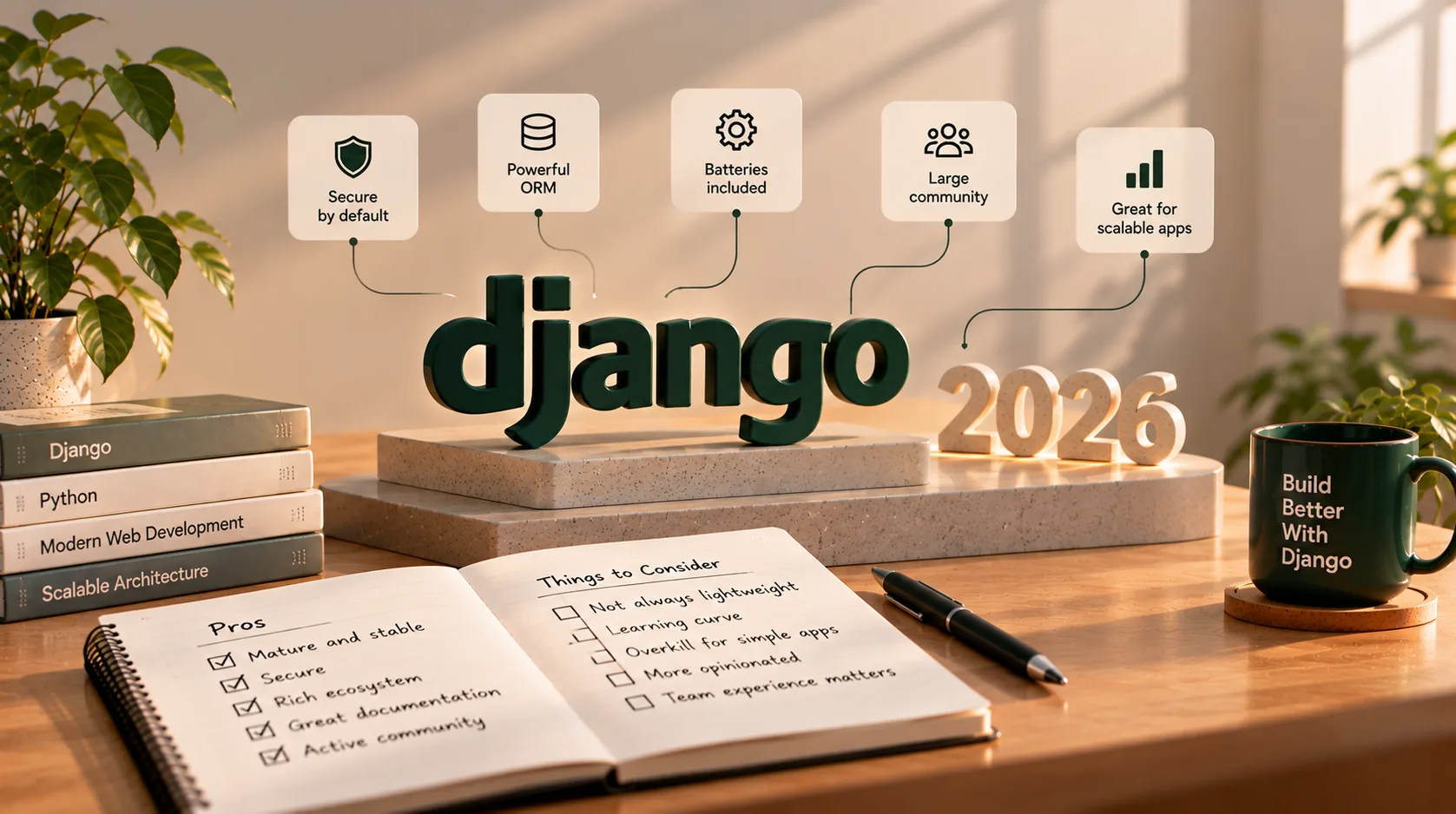
Is Django Still a Good Choice in 2026?
If you are choosing a framework for a new website, SaaS product, internal business tool, or startup MVP, you may be asking: is Django good in 2026, or has it fallen behind newer technologies?
It is a fair question. The web development ecosystem keeps changing. JavaScript frameworks have matured, serverless platforms have become more accessible, and developers have more choices than ever. Django is not the newest framework on the market, but being new is not the same as being the right tool.
The short answer: yes, Django is still a very good choice in 2026 for many data-driven web applications. It is particularly compelling when a project needs reliable data models, authentication, permissions, an admin interface, and a maintainable backend. It is not automatically the best choice for every product, and it will not remove the need for good architecture or experienced engineering.
This article looks at Django from a practical perspective: what it is good at, where it has limitations, what the current release means, and how to decide if it suits your next project.
What is the current Django version in 2026?
As of October 24, 2026, the official Django download page lists Django 6.1.2 as the latest official release. Django 6.1 was released on August 5, 2026. Its release highlights include configurable model-field fetch modes, database-level delete options for ForeignKey.on_delete, and dictionary-based email settings. Check the official Django download page before starting a project, because patch releases and support information can change.
Django's release policy and support windows matter just as much as the headline version number. The official page lists Django 6.1 as receiving mainstream support until April 2027 and extended support until December 2027. Django 5.2 is an LTS series with extended support listed through April 2028. For a business application, the right version is one that fits your Python and dependency requirements and has a support window that aligns with your maintenance plans.
Do not choose a version simply because it is the newest. Read the release notes, confirm compatibility with your dependencies, and plan upgrades deliberately.
Why Django is still relevant
1. It gives you a productive foundation
Django includes many building blocks a typical web application needs: URL routing, views, templates, forms, database models, migrations, authentication, sessions, and an admin site. Rather than assembling every basic capability from separate packages, a team can start with an integrated framework and add what the product needs.
That is useful for business applications where the challenge is managing users, records, workflows, permissions, and business rules reliably.
For example, a booking platform may need customer accounts, availability records, staff permissions, email notifications, and an administrative interface. Django provides a coherent base so the team can focus on product-specific requirements.
2. The ORM and migrations help manage data
Django's Object-Relational Mapper (ORM) lets developers define data models in Python and query the database through a consistent API. Its migration system helps track model changes and apply schema updates across development and deployment environments.
This is valuable when a product grows from a handful of tables into a connected data model involving customers, orders, appointments, subscriptions, or records.
The ORM is not a reason to ignore database fundamentals. Developers still need to understand indexes, query counts, transaction boundaries, constraints, and how to investigate slow queries. Django provides structure, but good data design still matters.
3. The admin site can save development time
Django's built-in admin is one of its most practical strengths. Once models and admin configuration are in place, authorised staff can search, review, create, update, and manage records.
It can be especially useful for:
- Internal operations and back-office tools
- Content and catalogue management
- Early-stage products that need staff workflows before a custom admin UI
- Support teams that need a controlled view of customer or order records
The admin is not a replacement for every customer-facing interface. If staff need a highly tailored workflow or polished visual experience, you may eventually build a dedicated interface. Still, starting with Django admin can help validate the underlying data model and workflow before investing in a custom UI.
4. Security features provide a strong starting point
Django includes protections and conventions for common web security concerns, including CSRF protection, XSS mitigation in templates, SQL injection protection through parameterised ORM queries, and secure password handling.
Those protections do not make an application automatically secure. Developers still need to configure production settings correctly, enforce object-level permissions, validate uploaded files, protect secrets, manage dependencies, use HTTPS, and keep the framework patched.
Use the official Django deployment checklist before a production launch. Treat it as a baseline, not a substitute for a security review.
5. Django can support APIs and modern frontends
Django does not require you to build every page using Django templates. It can serve HTML directly, expose API endpoints, or sit behind a separate frontend application. Teams commonly pair Django with Django REST Framework or other API approaches and build the interface with tools such as React, Vue, or a mobile application.
This flexibility lets you choose the frontend architecture based on the product instead of abandoning Django because the interface needs to be interactive.
However, a separate frontend and backend introduce additional decisions: authentication flow, API versioning, deployment, CORS configuration, coordination, and monitoring. Choose a split architecture because it solves a real requirement not simply because it sounds more modern.
What kinds of projects are a good fit for Django?
Django is particularly suitable when an application is centred on data, users, permissions, and business workflows.
| Project type | Why Django can fit |
|---|---|
| Business management software | Structured records, permissions, admin tools, and business rules |
| SaaS applications | User accounts, dashboards, and API support |
| Booking and scheduling systems | Connected models, validation, user roles, and workflow logic |
| Customer or patient portals | Authenticated access and carefully controlled data permissions |
| Content-heavy websites | Database-backed content and editorial administration |
| Internal tools | Fast development of forms, reports, and staff-facing workflows |
| MVPs and prototypes | A productive foundation for testing a business idea |
These are not guarantees of success. A booking system can still be difficult if it needs complex real-time availability, external integrations, or strict consistency under heavy concurrency. A SaaS platform may still require queues, caching, observability, and a scaling strategy. Django gives you a foundation; it does not make the product's engineering challenges disappear.
When Django may not be the best choice
A balanced evaluation should include the trade-offs.
You only need a simple static website
If the site consists of a few mostly static pages, a static site generator or managed website platform may be easier and cheaper to maintain. A full Django backend can add deployment and maintenance work without delivering much value.
Your team is strongest in another ecosystem
A framework is a long-term commitment to a way of building and maintaining software. If your team already has strong expertise in another stack and that stack fits the requirements switching to Django purely because it is capable may slow delivery.
The product is dominated by real-time connections
Django supports asynchronous views and can be used in asynchronous architectures, but a product built primarily around persistent connections, live collaboration, or high-frequency event processing needs careful architecture. You may need ASGI, a message broker, a specialised real-time layer, or a separate service for parts of the system. Evaluate the complete architecture rather than assuming one framework must handle everything.
You need specialised performance characteristics
Django can serve substantial production workloads, but performance depends on database design, caching, application code, infrastructure, and traffic patterns. If your core workload is unusual such as intensive numerical computing, ultra-low-latency processing, or a specialised streaming pipeline benchmark realistic workloads and consider whether another technology is better suited to that component.
You think it eliminates maintenance
No framework eliminates maintenance. Dependencies need updates, security advisories need attention, backups must be tested, and deployments must be monitored. Django's conventions can make maintenance more structured, but the team still needs a plan for it.
Is Django too old for a new project?
Django's age is not, by itself, a meaningful reason to reject it. A mature framework can offer stable conventions, extensive documentation, and a well-understood approach to common application problems. More useful questions are whether it is actively maintained, whether its supported versions fit your needs, whether the ecosystem supports your dependencies, and whether it matches your team's skills.
The current Django release cycle demonstrates that the project continues to ship releases and improvements. Django 6.1 introduced changes to model-field fetching and database deletion behaviour, among other improvements. Read the Django 6.1 release announcement and the release notes for details.
Framework maturity does not guarantee that every third-party package is actively maintained. Before selecting a dependency, check its recent releases, compatibility with your target Django and Python versions, issue activity, documentation, and licence.
Django vs. building a backend from smaller pieces
Some developers prefer a lightweight framework and select separate libraries for routing, data access, validation, authentication, and administration. That approach can work well, particularly when the project needs a small API or a deliberately minimal backend.
Django's advantage is integration: it offers a connected set of capabilities with established conventions. A lightweight stack's advantage is choice: you can select individual components and keep the foundation smaller when requirements are narrow.
Neither approach is universally superior. Compare the application's actual needs, the team's experience, the expected lifespan of the product, and the cost of maintaining the chosen stack. Do not compare only the number of lines needed to create the first endpoint.
What about AI-assisted development in 2026?
AI coding tools can help developers draft code, explain unfamiliar parts of a codebase, write tests, and investigate errors. They can also generate insecure patterns, outdated examples, or code that appears correct but fails under real conditions.
Django's conventions and documentation can make it easier to check generated code against a known framework structure. But AI assistance does not remove the need to understand authentication, authorisation, data modelling, migrations, query performance, testing, or deployment.
For a real business application, use AI to support engineering work not to replace code review, tests, security checks, and technical ownership.
How to decide if Django fits your project
Before committing, answer these questions:
- What are you building? List the core user journeys and business rules rather than starting with a technology preference.
- How much data and workflow logic is involved? Users, roles, records, forms, approvals, and reporting are often a good fit for Django.
- What does the frontend need? Decide whether server-rendered pages are enough or whether a separate frontend and API are justified.
- Which integrations are essential? Verify that payment providers, messaging services, analytics tools, and other required dependencies support your planned stack.
- What are the operational requirements? Define hosting, backups, monitoring, security, expected traffic, and recovery needs.
- Who will maintain the application? Consider team skills, hiring, documentation, and the expected life of the product.
- Which supported version will you use? Confirm the official support window and dependency compatibility before implementation.
A small proof of concept can help answer uncertain questions. Build one representative workflow, test the most important integration, and measure performance against realistic data. That is more informative than choosing a framework based on online arguments.
Final verdict: Is Django good in 2026?
Yes, Django remains a strong and practical choice in 2026, especially for data-driven web applications, SaaS products, internal tools, content platforms, and business software that needs authentication, permissions, administration, and a maintainable backend.
Its biggest strengths are productivity, integrated features, structured data handling, and mature conventions. Its limitations are equally worth acknowledging: it may be unnecessary for a simple static site, and specialised real-time or performance-sensitive workloads may require additional components or a different approach.
Choose Django when its strengths match the product not because it is popular, and not because it is familiar. Keep the framework and dependencies supported, follow the deployment checklist, test the workflows that matter, and plan for maintenance from the beginning.
If you are planning a web application and want help evaluating the right architecture, scope, or development approach, get in touch to discuss your project.