
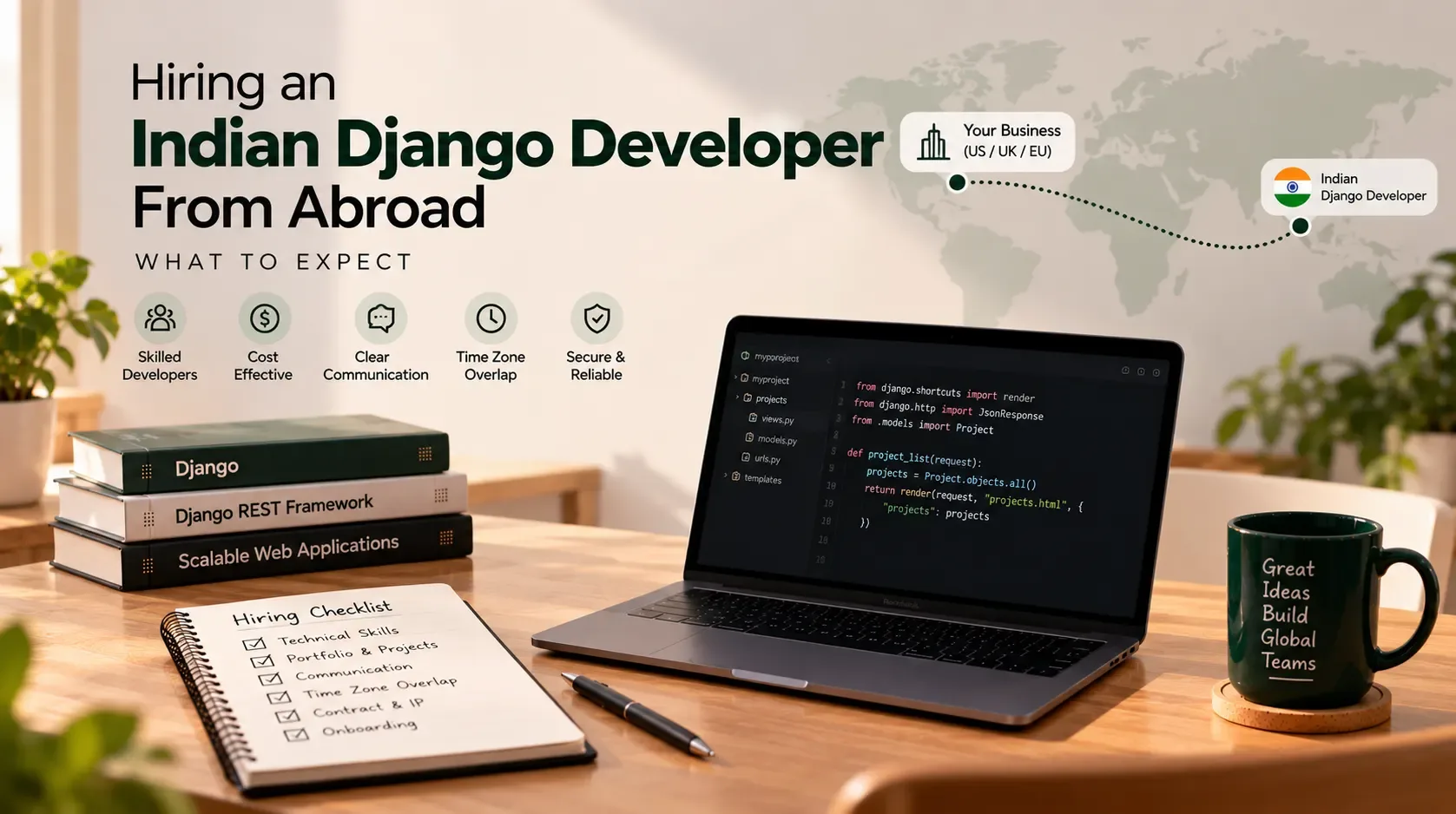
Hiring an Indian Django Developer From Abroad: What to Expect
Hiring a Django developer in another country can give your business access to technical skills without requiring everyone to work in the same office. But a successful remote engagement involves more than finding someone who knows Python and Django. You also need clear requirements, reliable communication, secure access, a sensible contract, and a plan for delivering and maintaining the software.
If your business is in the US, UK, Europe, Australia, or elsewhere and you are considering hiring an Indian Django developer, this guide explains what the process typically involves, what to verify before you commit, and how to set up the working relationship for success.
The aim is not to assume that every developer or engagement works the same way. Experience, pricing, availability, working hours, and legal arrangements vary. Instead, use this guide as a framework for evaluating the right fit for your project.
Why consider hiring a Django developer in India?
Django is a Python web framework used to build database-backed websites, internal tools, business platforms, and APIs. It includes features such as an ORM, URL routing, authentication building blocks, forms, and an administrative interface. These capabilities can help teams build maintainable applications without implementing every common web feature from scratch.
Working with an Indian Django developer may be a good fit when you need to:
- Build a new web application or minimum viable product (MVP).
- Add or improve REST APIs using Django REST Framework.
- Maintain or modernize an existing Django codebase.
- Build internal dashboards, portals, or workflow tools.
- Integrate third-party services with an existing application.
- Improve database queries, tests, security, or deployment practices.
- Add development capacity without recruiting locally.
The right decision depends on the developer's actual experience, communication, availability, and ability to understand your business—not just their location or hourly rate.
1. Decide what kind of engagement you need
Before reviewing candidates, decide whether you need someone to deliver a defined project, contribute regularly to your team, or become a long-term employee. These are different hiring problems.
| Engagement model | Best suited to | What to clarify |
|---|---|---|
| Independent freelancer or contractor | A defined feature, audit, integration, or short-to-medium engagement | Scope, availability, payment schedule, ownership, support, and termination terms |
| Dedicated developer through a development company | Ongoing development with a provider handling the commercial relationship | Who manages the developer, replacement arrangements, continuity, and handover |
| Project-based development team | A project needing several skills, such as backend, frontend, QA, and deployment | Deliverables, responsibilities, milestones, acceptance criteria, and change control |
| Direct employee through an appropriate local arrangement | A long-term role where you want the person embedded in your organization | Employment structure, payroll, benefits, local compliance, and management responsibilities |
| Employer of Record (EOR) arrangement | A business that wants a team member employed locally without immediately setting up its own entity | EOR fees, employment terms, responsibilities, and applicable local requirements |
Do not choose a model only because it appears cheaper. A freelancer may be ideal for a well-defined task but less suitable when you need a full product team. A development company may provide continuity and broader capabilities, but you should still establish who will do the work and how quality will be assessed.
If you intend to employ someone directly in India, get professional advice on employment, payroll, tax, and compliance in the relevant jurisdictions. Contractor, employee, and EOR arrangements are not interchangeable.
2. Write a clear Django developer brief
A vague request such as “I need a Django developer to build my platform” makes it difficult for candidates to estimate effort or for you to compare proposals.
Your brief should explain the business problem, users, expected outcome, existing systems, and constraints.
Include:
- Project context: What does the business do, and why is this application needed?
- User groups: Who will use the product—customers, staff, administrators, or partners?
- Core workflows: What should users be able to do from beginning to end?
- Current state: Is this a new application, an existing Django project, or a migration from another stack?
- Technical environment: Known framework versions, database, hosting, repositories, and integrations.
- Deliverables: Code, tests, documentation, deployment, migration, or training.
- Constraints: Budget range, target dates, availability requirements, security expectations, and dependencies.
- Acceptance criteria: How will you decide that the work is complete?
You do not need to make every technical decision before hiring. A capable developer should help identify unknowns and propose sensible options. But you should be able to explain the business problem and the result you need.
For a larger or unclear project, consider a paid discovery phase before committing to a full build. It can produce a scoped backlog, technical plan, risk register, and more credible estimate.
3. What Django skills should you look for?
A developer's resume may list Django, Python, REST APIs, and databases. The interview should establish how deeply they have used those skills and whether they can apply them to your project.
Core backend skills
Look for evidence of experience with:
- Python fundamentals, readable code, and error handling.
- Django models, views, URL routing, forms, middleware, and migrations.
- Django ORM queries, relationships, transactions, and constraints.
- Authentication, authorization, permissions, and secure data handling.
- REST API design and Django REST Framework where relevant.
- Relational databases such as PostgreSQL or MySQL, depending on your stack.
- Automated tests and debugging.
- Git, code review, and a repeatable deployment process.
The required depth depends on the role. A developer maintaining a small internal tool may not need the same experience as someone designing a high-traffic, multi-tenant platform.
Production-level judgment
Beyond syntax, ask how the developer approaches real engineering trade-offs:
- How would they diagnose an endpoint that has become slow?
- How would they prevent one customer from accessing another customer's records?
- How would they manage a risky database migration?
- How would they test a payment or booking workflow?
- What would they do if a background task failed after the database transaction committed?
- How would they deploy a change without breaking the existing application?
You are looking for a reasoned approach: measure first, explain alternatives, address failure cases, and verify the result.
Portfolio and code review
Ask the developer to walk you through a project they are allowed to discuss. Useful questions include:
- What did you personally build?
- What was the hardest technical problem?
- What trade-offs did you make, and why?
- How did you test the feature?
- What would you improve if you built it again?
A public GitHub repository can be useful evidence, but not every professional project can be public. Confidential client work may be subject to restrictions. A private code walkthrough, a permitted sample, or a small practical exercise can help fill the gap.
4. Use a practical assessment not just trivia
A long list of interview questions can test recall without showing whether someone can deliver useful software. A focused practical assessment is often more revealing.
For example, give the candidate a small task involving a Django model, an API endpoint, input validation, and a test. Ask them to explain their choices and identify what they would change for production.
A useful assessment should:
- Resemble the type of work they will actually do.
- Have a clear time limit and evaluation criteria.
- Avoid asking candidates to build a large unpaid feature for your business.
- Evaluate code clarity, correctness, testing, security, and communication.
- Include a discussion of edge cases and alternative approaches.
If you use a paid trial, agree on scope, compensation, confidentiality, and ownership of the work in advance. Keep the exercise small enough that both sides can judge the fit without creating an unclear commercial relationship.
5. Understand communication and time-zone overlap
Remote work can succeed across time zones, but the working arrangement must be explicit. India uses Indian Standard Time (IST), UTC+5:30, and does not observe daylight saving time. The time difference between India and your location may change during the year if your country changes its clocks.
The amount of useful overlap depends on where your team is based and when each person works. UK and European teams often have a more convenient shared window with India than teams on the US West Coast. US-based teams may need a planned evening overlap in India or a workflow that relies more heavily on asynchronous communication.
Before hiring, agree on:
- Core hours when both sides are available.
- The number and timing of recurring meetings.
- Expected response times for routine questions and urgent blockers.
- How daily progress and blockers will be reported.
- Where requirements, decisions, and technical notes will be recorded.
- Whether evening or overnight work is required, how often, and how it is compensated or reflected in the schedule.
Avoid assuming that “remote and flexible” means unlimited availability. A sustainable schedule and clear expectations are more useful than vague promises to work any hours.
Make asynchronous communication work
Use a shared task tracker, source-control platform, and documentation space. For each task, record the goal, context, acceptance criteria, dependencies, and relevant design decisions.
A concise daily update can answer three questions:
- What was completed?
- What is next?
- What is blocked or needs a decision?
This helps the client review progress without scheduling a meeting for every small question. Important decisions made on calls should be summarized in writing so both sides have a consistent record.
6. How should you manage the project?
A remote developer should understand how the work connects to the business outcome. At the same time, the client needs a clear way to track scope, quality, and risk.
For a small project, a simple workflow may be enough:
- Agree on the scope and acceptance criteria.
- Break work into small tasks or milestones.
- Track tasks in a shared board.
- Use version control and pull requests or code reviews.
- Test work in a staging environment.
- Demonstrate completed features.
- Record decisions and update documentation.
- Release through an agreed deployment process.
For larger projects, add architecture reviews, QA planning, release management, and more formal risk tracking where needed.
Measure progress through observable outcomes: completed workflows, reviewed code, passing tests, resolved defects, and successful releases. Hours logged can help with capacity planning, but they are not proof that the application is working correctly.
7. Contracts, intellectual property, and confidentiality
Do not leave ownership or confidentiality to assumptions. Paying an invoice does not, by itself, explain every question about ownership of code, designs, documentation, or pre-existing components.
Before development begins, have the agreement reviewed by a qualified professional for the relevant jurisdictions. It should address the points that matter to your engagement, such as:
- Scope of work and deliverables.
- Fees, currency, invoicing, payment deadlines, and expenses.
- Acceptance criteria and how changes are approved.
- Confidentiality and permitted use of business information.
- Ownership and assignment of newly created intellectual property.
- Treatment of pre-existing code, open-source software, and third-party components.
- Data protection and security responsibilities.
- Working hours, availability, and communication expectations.
- Support, defect correction, maintenance, and warranty terms.
- Termination, notice, payment for completed work, and handover.
- Applicable law and dispute-resolution process.
Make sure the intellectual-property arrangement matches the actual engagement chain. If you contract with a company that supplies a developer, confirm how the company obtains the necessary rights from its personnel and transfers the agreed rights to you.
This is general project-planning information, not legal advice. Cross-border engagements may involve employment classification, tax, privacy, and data-transfer obligations. Get advice that fits your business and the countries involved.
8. Keep code, accounts, and customer data secure
Security should be part of the onboarding process, not an afterthought.
Use accounts controlled by your business for the repository, cloud hosting, task tracker, and other important services. Grant the developer only the access needed for their role, and use individual accounts rather than sharing one password.
Agree on practical controls:
- Store secrets in an approved secrets manager or environment configuration not in source code.
- Use multi-factor authentication where available.
- Avoid copying production customer data into development environments unless there is a justified, protected process.
- Use test data or masked datasets when possible.
- Review dependencies and keep supported versions updated.
- Protect production access and log important administrative actions.
- Back up important data and test restoration.
- Revoke access and rotate credentials when the engagement ends, as appropriate.
The goal is not to make remote work difficult. It is to let the developer work efficiently without giving unnecessary access to your business or customers.
9. What should you expect during onboarding?
A developer cannot contribute effectively if they are given a repository link but no context, access, or explanation of the product.
A sensible onboarding plan might look like this:
Before the start date
- Confirm the contract, scope, schedule, and payment terms.
- Create individual accounts and grant least-privilege access.
- Share the project brief, architecture notes, and current backlog.
- Identify the person who can answer product and business questions.
- Arrange an introductory call and agree on communication channels.
First few days
- Get the project running locally or in the approved development environment.
- Review the architecture and key workflows.
- Identify how tests, migrations, and deployments work.
- Agree on coding conventions, branching, and review expectations.
- Choose a small first task that can be reviewed end to end.
First one to two weeks
- Complete a bounded feature, fix, or technical investigation.
- Review the code and tests together.
- Confirm that the developer understands the release process.
- Discuss any gaps in requirements, access, or documentation.
- Adjust the plan based on what the first task revealed.
The exact schedule depends on the project's size and condition. An inherited legacy application may need more discovery before a feature can be delivered safely.
10. Pricing: what should you compare?
There is no single rate that applies to every Indian Django developer. Cost varies with experience, specialization, project complexity, availability, engagement model, and the amount of responsibility included.
Instead of comparing hourly or monthly rates alone, compare the complete arrangement:
| Cost factor | Questions to ask |
|---|---|
| Seniority | How independently can the developer handle design decisions, debugging, and production issues? |
| Scope | Is the person implementing defined tasks or responsible for architecture and delivery? |
| Availability | How many hours or days are included, and what overlap is expected? |
| Quality assurance | Who writes and runs tests? Is QA included or separate? |
| Delivery management | Who handles planning, reviews, releases, and communication? |
| Maintenance | Are bug fixes, monitoring, upgrades, and support included? |
| Infrastructure | Who pays for hosting, third-party APIs, licenses, and other services? |
| Risk and continuity | What happens if the developer becomes unavailable or the engagement ends? |
A low initial quote can become expensive if the scope is unclear, testing is excluded, or no one is responsible for deployment and handover. A higher quote is not automatically better either. Ask each candidate to explain assumptions, exclusions, risks, and what successful delivery includes.
For a new or poorly documented application, consider budgeting for discovery before requesting a fixed implementation quote. It is difficult to estimate unknown integrations, data quality issues, and legacy behavior accurately without examining them.
11. Common warning signs
Be careful if a candidate or provider:
- Promises a complex build before understanding the requirements.
- Cannot explain which parts of a portfolio they personally delivered.
- Avoids discussing tests, security, deployment, or data migration.
- Requests unrestricted access to production systems without a reason.
- Wants all important project accounts to remain under their own control.
- Cannot describe how they will communicate blockers or changing estimates.
- Treats every requested change as included, but provides no scope or change process.
- Offers a very low fixed price while leaving major assumptions undefined.
- Cannot provide a credible handover plan or explain how another developer could maintain the code.
One warning sign does not prove a candidate is unsuitable. Ask follow-up questions and look for clear, verifiable answers.
12. Questions to ask before you hire
Use this checklist during your interviews or discovery calls.
Technical fit
- Which Django and Python projects have you worked on that are relevant to this one?
- What did you personally implement?
- How would you approach testing, security, and deployment?
- How do you investigate performance issues and database problems?
- What information would you need before estimating this project?
Working relationship
- What hours can you reliably overlap with our team?
- How do you report progress and raise blockers?
- Who reviews the code?
- What happens when the scope changes?
- How will knowledge be documented and handed over?
Commercial and operational
- What is included in the quote, and what is excluded?
- What are the payment milestones and invoice terms?
- Who owns the repository, infrastructure, and project accounts?
- How are intellectual property and confidentiality handled?
- What support is available after launch?
- What happens if either side ends the engagement?
A practical final test
Ask the candidate to explain how they would approach one real problem from your project. Listen for clarifying questions, assumptions, trade-offs, and a plan to verify the result. Strong engineers do not always know every answer immediately; they should be able to reason carefully and identify what needs investigation.
13. Is hiring an Indian Django developer right for your project?
It can be a strong fit when you have a clear business need, can work effectively across time zones, and have a reliable way to review and accept the work. It may be less suitable if the role requires continuous in-person collaboration, immediate real-time availability across a large time difference, or access to systems that cannot be safely shared under your compliance requirements.
You should also decide whether you need an individual developer or a team. A solo developer may be enough for a focused API or internal tool. A larger product may need design, frontend development, QA, DevOps, and project management in addition to Django expertise.
The right arrangement is the one that fits your delivery risk, technical requirements, communication needs, and budget not simply the one with the lowest quote.
Frequently asked questions
Can a company in the US or UK hire a Django developer in India?
International businesses can work with Indian developers through different arrangements, including independent contracting, a development company, an Employer of Record, or an appropriate local employing entity. The right option depends on the relationship and applicable legal, tax, and employment requirements. Get professional advice before choosing an arrangement.
Will the time difference make collaboration difficult?
Not necessarily. Agree on a realistic overlap window and use written briefs, shared task tracking, recorded demonstrations, and clear escalation rules. The amount of overlap you need depends on how frequently the work requires live decisions.
Should I hire a freelancer or a development company?
A freelancer may be a good fit for a defined task or when you can manage the technical work directly. A development company may be more appropriate when you need multiple roles, delivery management, or continuity. Compare the actual people, responsibilities, costs, and terms rather than relying on the label.
How can I check a Django developer's experience?
Review relevant project examples, ask what they personally built, discuss technical decisions, and use a small practical assessment with clear criteria. Evaluate code quality, tests, security awareness, and communication—not just framework trivia.
Who owns the code after the project is complete?
Ownership depends on the contract and applicable law. Put intellectual-property assignment and treatment of pre-existing or third-party components in writing, and ensure that the rights flow through any company or subcontractor involved.
What should I prepare before requesting a quote?
Prepare a short project brief, key workflows, target users, current technical details if available, integrations, constraints, expected deliverables, and a budget range if you have one. If the application is complex or undocumented, ask for a discovery phase before requesting a fixed-price estimate.
Ready to discuss your Django project?
If you are looking to hire a Django developer from India, start with the business problem you need to solve: a new web application, a REST API, an internal tool, a legacy-system improvement, or ongoing development support.
Contact Sajid Kalam to discuss your requirements, current technical situation, and next steps. A useful initial conversation should clarify the scope, identify unknowns, and help determine whether the project is a good fit before you commit to a larger engagement.
You can also explore Sajid Kalam's projects for examples of web application and software development work.
Further reading
- Django documentation — official reference for Django features and best practices.
- Django REST Framework documentation — official guide to building Web APIs with DRF.
- Django deployment checklist — useful when evaluating production readiness.
- How to Hire a Django Developer: Checklist — a related hiring resource.