
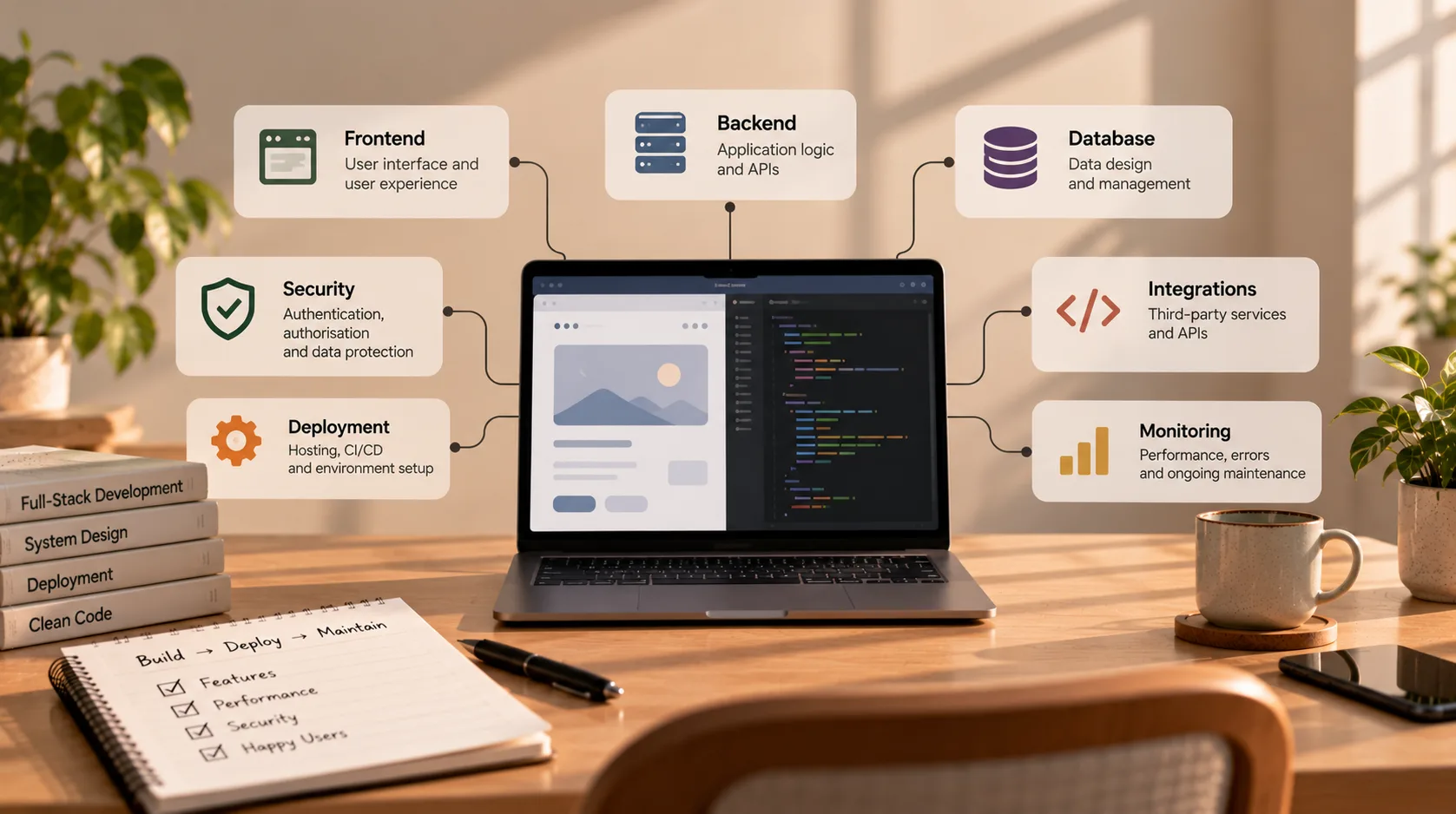
Full-Stack Developer Responsibilities in a Production App
A web application can look finished in a demo and still be far from ready for real users.
The interface may load, the forms may work, and the main workflow may appear complete. But a production application also needs reliable data handling, secure access, useful error messages, tests, deployment procedures, and a plan for fixing problems after launch.
This is where the responsibilities of a full-stack developer extend beyond writing frontend and backend code.
A full-stack developer works across the user-facing interface and the server-side systems that support it. In a production web app, they may take responsibility for connecting those layers into a complete, maintainable feature. The exact scope depends on the team: in some organisations, infrastructure, security operations, and production support are shared with dedicated specialists.
For hiring managers, understanding these boundaries helps set realistic expectations. For junior developers, it shows what building software for real users involves.
What Does “Ownership” Mean in Production?
Ownership does not mean one developer must do every task alone or be personally responsible for every possible failure. It means they understand the part of the application they are working on, can explain how it behaves, and follow through on making it work as intended.
For example, imagine adding appointment booking to a web application. A feature is not complete just because a user can click a time slot. The application must also check availability, validate the request, save the booking correctly, handle conflicts, show an appropriate result, and provide a way to investigate failures.
A full-stack developer may coordinate that work across the frontend, API, database, tests, and deployment process.
1. Frontend Experience and User Workflows
The frontend is the part of the application people see and interact with. A full-stack developer may be responsible for building screens, forms, navigation, reusable components, and the states users encounter while completing a task.
Production ownership means considering more than the ideal path. What happens when a form is incomplete? What if a request takes several seconds? What should the user see when there are no results, a session expires, or an API returns an error?
Common responsibilities include:
- Building responsive interfaces that work across relevant screen sizes.
- Connecting user actions to backend APIs.
- Showing loading, success, empty, and error states.
- Validating input in the interface while ensuring the server validates it too.
- Keeping components understandable and maintainable.
- Considering accessibility and clear interaction patterns.
The goal is not simply to make a screen look right. It is to make the workflow understandable and dependable for users.
2. Backend Logic and API Contracts
The backend processes requests, applies business rules, and communicates with databases or external services. A full-stack developer may build API endpoints, validate requests, manage application logic, and decide how the frontend receives results.
A useful API contract defines what a request needs, what a successful response contains, and how errors are represented. This matters because the frontend and backend must agree about how a feature behaves.
For example, a booking API should not simply accept any requested time and return success. It may need to check that the user is authorised, the time slot is valid, and the slot has not already been taken.
In production, backend ownership often includes:
- Validating data on the server.
- Returning predictable response formats and status codes.
- Handling expected failures without exposing sensitive internal details.
- Avoiding duplicate or inconsistent operations where appropriate.
- Keeping business rules in the right layer instead of scattering them throughout the application.
3. Data Models and Data Integrity
A production app often stores information that must remain consistent over time: user accounts, bookings, orders, messages, or business records.
A full-stack developer may design database tables or collections, define relationships, write queries, and update the data model as requirements evolve. They also need to understand how a code change affects existing records.
For example, adding a new required field to a database can break older records or deployments if the migration is not planned properly. A production-ready change should consider how existing data will be handled, not just how a new record is created.
Data ownership may involve:
- Choosing a suitable data model.
- Using constraints and transactions where needed to protect consistency.
- Writing and reviewing database migrations.
- Avoiding unnecessary queries and investigating slow ones.
- Considering backup, recovery, and data retention requirements with the team.
Not every full-stack developer is the database administrator, but they should understand the consequences their application code has on stored data.
4. Authentication, Authorisation, and Application Security
A login form is only one part of application security. Production applications need to verify identity and enforce what each user is allowed to see or change.
Authentication answers, “Who is this user?” Authorisation answers, “What can this user do?”
A full-stack developer may implement login flows, session or token handling, password-reset functionality, and role-based permissions. They should also make sure the backend checks access to protected resources rather than relying only on buttons being hidden in the frontend.
Other important practices include validating untrusted input, protecting secrets, using secure configuration, and avoiding sensitive information in logs or error responses.
Security is a shared responsibility. Depending on the product and organisation, formal security reviews, penetration testing, infrastructure hardening, and compliance work may require dedicated specialists. The developer should identify risks and work with the right people rather than assuming that a working login makes an application secure.
5. Testing Beyond the Happy Path
A feature that works once with ideal data may still fail in real use. Production ownership includes checking important success and failure scenarios before changes reach users.
Testing may include:
- Unit tests: check small pieces of logic in isolation.
- Integration tests: check whether components such as APIs and databases work together.
- End-to-end tests: check important user workflows across the application.
- Manual exploratory testing: investigate edge cases that automated tests may not cover.
For an appointment feature, tests might check a valid booking, a missing field, an unauthorised request, and two users attempting to book the same slot.
A full-stack developer does not necessarily write every test personally on a large team, but should understand the coverage needed and help make sure changes are tested appropriately.
6. Deployment and Environment Configuration
Code must move from a development environment into a production environment without relying on undocumented steps or local machine settings.
Depending on the team, a full-stack developer may prepare application configuration, manage environment variables, run database migrations, check build output, and help deploy releases. They may also work with a DevOps or platform engineer who owns the underlying infrastructure and deployment pipeline.
Production configuration should keep secrets out of source code and separate environment-specific settings from the application itself. A release process should make it possible to identify what version is running and investigate problems if a deployment fails.
Before release, teams commonly check that the application builds, critical tests pass, required settings are present, and the most important workflows work in a production-like environment.
7. Performance, Errors, and Monitoring
Launching an application is not the end of development. Real users may discover slow pages, unexpected inputs, browser-specific issues, or failures that were not visible during testing.
A full-stack developer may investigate slow API responses, inefficient database queries, large frontend bundles, repeated requests, or expensive operations. They may use logs, error tracking, performance metrics, and reports from users to understand what is happening.
Useful production practices include:
- Logging enough context to diagnose issues without exposing sensitive data.
- Tracking errors and investigating recurring failures.
- Measuring performance instead of guessing at the cause.
- Handling failures from third-party services.
- Improving bottlenecks based on evidence.
- Documenting how to respond to common incidents.
Monitoring platforms and alerting systems may be managed by another team. Even so, developers should understand how to find evidence when their code behaves differently in production.
8. Maintenance, Documentation, and Handover
Production software changes continuously. Dependencies need updates, requirements evolve, and new features can introduce regressions.
A full-stack developer may review dependencies, fix bugs, refactor confusing code, document important decisions, and help other developers understand the system. They should also make sure another team member can run the application, understand its configuration, and follow the deployment process.
Useful documentation does not need to describe every line of code. It should explain what is difficult to infer: how to set up the project, which environment variables are required, how data migrations work, how releases are deployed, and where to investigate common failures.
Good documentation reduces the risk of a product depending on one person's memory.
What Should a Full-Stack Developer Own and What Should Be Shared?
Responsibilities vary by company size, product risk, and team structure. A small startup may ask a full-stack developer to handle much of the application lifecycle. A larger team may divide responsibilities among frontend, backend, QA, security, and platform engineers.
| Area | Typical developer responsibility | May be shared with |
|---|---|---|
| Frontend and user workflows | Build and maintain UI behavior | Product designer, frontend specialist |
| APIs and business logic | Implement and maintain application behavior | Backend specialist, technical lead |
| Database changes | Design models and handle application-level migrations | Database administrator, backend specialist |
| Security | Follow secure coding practices and implement access checks | Security team, platform team |
| Testing | Test changes and fix defects | QA engineer, test automation specialist |
| Deployment | Prepare code and support releases | DevOps or platform engineer |
| Monitoring and incidents | Investigate application errors | SRE, operations, support |
| Documentation and handover | Explain setup, decisions, and workflows | Whole engineering team |
The key is to define ownership explicitly. “Full-stack” describes the range of development work someone can handle; it does not automatically mean they are an expert in infrastructure, security, design, testing, and every operational discipline.
A Production Readiness Checklist for Hiring Managers
Before considering a feature complete, ask whether the developer or team has addressed the following:
- The main user workflow works from beginning to end.
- Inputs are validated on the server, and permissions are enforced.
- Data changes preserve consistency and include an appropriate migration plan.
- Important success and failure cases are tested.
- Errors are handled without exposing sensitive details.
- Production settings and secrets are configured safely.
- The release process is documented and repeatable.
- There is a practical way to investigate production errors.
- Key setup and maintenance steps are documented.
- Someone is identified to maintain the application after launch.
This checklist is not a substitute for a project-specific security or operational review. It is a starting point for discussing what “done” means before a feature reaches real users.
Final Thoughts
A full-stack developer's responsibility in a production web app goes beyond connecting a frontend to a backend. They help make sure the complete feature behaves correctly, handles data carefully, respects access rules, can be tested and deployed, and remains maintainable after release.
They do not need to own every organisational function alone. What matters is that responsibilities are clear, risks are raised early, and no critical part of the application is left without an owner.
For hiring managers, define the expected level of production ownership before hiring. For junior developers, build the habit of thinking about validation, failure states, tests, deployment, and maintenance not only whether the code works on your machine.