
Introduction
Building a web application involves more than choosing a programming language or framework. You also need to decide who will build it.
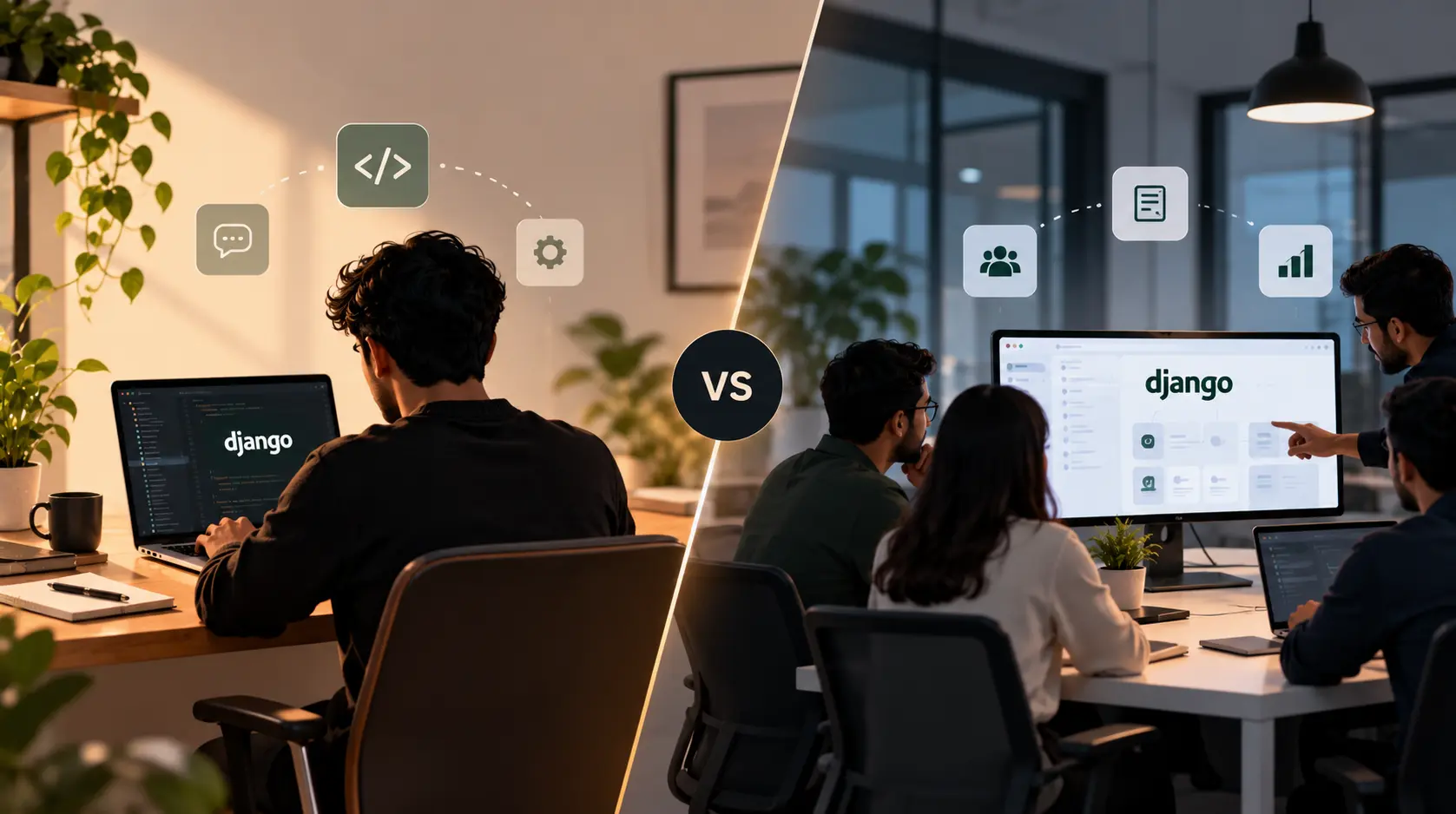
If you're planning a Django-based website, business platform, customer portal, or minimum viable product (MVP), two common options are hiring a freelance Django developer or working with a software development agency.
Both can be suitable choices. A freelancer may offer direct communication, flexibility, and a focused working relationship. An agency may provide access to multiple specialists, structured project management, and a broader range of services.
Neither option is automatically better for every business. A small business that needs a few API endpoints may not require an entire development team. A company building a complex application with several integrations, a separate frontend, extensive testing, and ongoing maintenance may need more resources than one developer can reasonably provide.
The right decision depends on what you're building, how much support you need, your budget, and how you want the project to be managed.
What Is a Freelance Django Developer?
A freelance Django developer is an independent professional who builds, improves, or maintains web applications using Django, a Python web framework.
Depending on their experience, a freelancer may help with:
- Building a Django web application or MVP.
- Developing backend functionality and business logic.
- Creating REST APIs using Django REST Framework.
- Designing database models and handling data migrations.
- Implementing authentication and user permissions.
- Integrating third-party services.
- Fixing bugs and improving existing applications.
- Deploying applications and maintaining production systems.
Freelancers may work on an hourly, fixed-price, milestone-based, or monthly arrangement. For example, a small business might hire one to build a customer dashboard, connect an existing application to an external API, or develop the backend for an MVP.
The key advantage is that you work directly with the person responsible for the development work. However, their ability to manage the entire project depends on their skill set, availability, and experience. A backend-focused developer may not offer professional design, extensive quality assurance, or every other service your project requires.
What Is a Software Development Agency?
A software development agency is a company that provides software development services through an individual or team of professionals.
Depending on its size and services, an agency may provide:
- Backend and frontend development.
- UI/UX design.
- Database architecture and API integration.
- Quality assurance and testing.
- Cloud deployment and infrastructure support.
- Project management, documentation, and maintenance.
For a Django project, an agency might assign a backend developer to build the application, a frontend developer to implement the interface, a tester to verify functionality, and a project manager to coordinate delivery.
This can be useful when the project involves several disciplines or requires multiple people to work simultaneously. However, agency structures vary. Some have dedicated in-house teams, while others use contractors or outsource parts of the work. The number of people involved does not automatically guarantee better quality.
Before hiring an agency, understand who will work on your project, who will make technical decisions, and who will be accountable for delivery.
Freelance Django Developer vs Agency: A Quick Comparison
| Factor | Freelance Django developer | Software development agency |
|---|---|---|
| Cost structure | Often lower overhead for a focused engagement | May include team, management, and operational costs |
| Communication | Usually direct with the developer | May involve a project manager and multiple team members |
| Team size | Usually one primary professional | Can provide multiple specialists |
| Flexibility | Often suitable for smaller tasks and evolving priorities | Depends on contracts, processes, and availability |
| Project management | May be handled by the freelancer or client | May include dedicated project coordination |
| Technical expertise | Depends on the individual's skills | May provide a wider range of expertise |
| Speed | Can be efficient for well-defined tasks | Parallel work may help with larger projects |
| Availability | Can be affected by the freelancer's workload | May have backup resources, depending on the agency |
| Best suited for | Focused features, MVPs, integrations, and maintenance | Larger projects requiring several disciplines |
This comparison is a starting point, not a universal rule. An experienced freelancer may deliver a more reliable result than an unsuitable agency, while a well-managed agency may be better equipped for a complex project.
1. Compare the Total Cost, Not Just the Quoted Price
Budget is often one of the first considerations for small-business owners. A freelance Django developer may be less expensive for a narrowly defined project because you are usually paying for an individual's time rather than a broader organisational structure. An agency's quote may account for several roles, project coordination, quality assurance, design, and other services.
Comparing quotes directly can be misleading if the deliverables differ. Imagine you need a customer portal with login functionality, a database, an administrative dashboard, and API integration. A freelancer might quote for backend development alone, while an agency might include interface design, backend development, testing, deployment, and documentation.
Before comparing prices, ask both parties to specify:
- Which features and deliverables are included.
- Whether design and frontend development are included.
- Whether testing, deployment, documentation, and handover are covered.
- How revisions and additional requirements are priced.
- Whether ongoing maintenance is available.
- Which third-party services or infrastructure costs are excluded.
Practical advice: Compare proposals against the same scope of work. A transparent quote is more useful than an attractive price that leaves important responsibilities undefined.
For more on preparing for a hiring decision, read the Django developer hiring checklist.
2. Consider the Complexity of Your Django Project
When a freelancer may be enough
A freelance Django developer may be a good fit when requirements are clearly defined and the work can reasonably be handled by one person. Examples include:
- Building a straightforward business website with Django.
- Developing REST API endpoints.
- Adding authentication or role-based permissions.
- Fixing bugs in an existing application.
- Connecting a Django backend to a third-party service.
- Building a prototype or MVP with a limited feature set.
- Improving database queries or maintaining an existing codebase.
For these projects, working directly with a developer can reduce coordination overhead and keep communication straightforward.
When an agency may be more suitable
An agency may be worth considering when the application requires several specialists or substantial parallel work. Examples include:
- A complex SaaS platform with multiple user roles.
- A customer portal requiring separate frontend and backend development.
- An application with numerous external integrations.
- A product requiring dedicated design, testing, and development resources.
- A large migration involving several systems.
- A project with multiple workstreams and a demanding delivery schedule.
An agency is not the only option for these projects. You could hire a lead developer and bring in additional specialists when necessary. The important question is whether the available team can meet the project's requirements without creating unnecessary complexity.
3. Evaluate the Technical Skills You Actually Need
The word Django describes only one part of a developer's technical capability. Depending on your application, you may also need experience with Python, Django REST Framework, relational databases, frontend technologies, cloud infrastructure, automated testing, and security practices.
A freelancer may specialise in backend development or be comfortable working across the frontend, backend, database, and deployment process. An agency may offer these capabilities collectively, but verify that the people assigned to your project have the relevant experience.
Ask questions such as:
- Have you built an application with requirements similar to mine?
- How would you structure the database?
- How will authentication and user permissions be implemented?
- What testing will be performed before release?
- How will the application be deployed and maintained?
- What documentation will be available at handover?
Ask candidates to explain their reasoning rather than simply listing technologies. You can review Sajid Kalam's projects and case studies for examples of project write-ups describing the problem, technical approach, and implementation.
4. Think About Communication and Project Management
With a freelancer, you generally communicate directly with the person writing the code. This can make it easier to clarify requirements, discuss technical decisions, and respond to feedback. However, direct communication does not mean project management happens automatically. You may still need to organise meetings, prioritise features, provide feedback, and make decisions promptly.
An agency may offer a project manager who coordinates requirements, deadlines, team members, and progress updates. This can help when you do not have the time or experience to manage a technical project yourself. On the other hand, several layers of communication can sometimes slow decisions if responsibilities are unclear.
Before signing an agreement, establish:
- Who will be your primary point of contact.
- How often progress updates will be shared.
- Which tools will be used to track tasks and issues.
- How quickly questions and blockers should be addressed.
- Who approves changes to the scope.
- How milestones and acceptance criteria will be defined.
Choose the arrangement that matches your availability and management preferences.
5. Understand Accountability and Ownership
Who is responsible if something goes wrong? This is important whether you hire a freelancer or an agency.
When working with a freelancer, you have a direct relationship with the person delivering the work. With an agency, responsibilities may be distributed among developers, testers, and project managers. In either case, your agreement should explain:
- The scope of work and expected deliverables.
- Milestones, payment terms, and acceptance criteria.
- Ownership of the source code and other project assets.
- Access to the source-code repository and deployment environment.
- Responsibilities for credentials, backups, and documentation.
- How defects and post-launch issues will be handled.
- What happens if the engagement ends before completion.
For a business application, retain appropriate access to your project assets and systems. Do not leave critical credentials, source code, or operational knowledge accessible only through one individual's personal account.
6. Consider Availability, Continuity, and Long-Term Support
Software development does not necessarily end when the application launches. You may need security updates, bug fixes, new features, database changes, performance improvements, or help adapting the application as your business grows.
A freelancer can be an excellent long-term development partner if they have the required skills and can commit to an appropriate level of availability. However, one person's capacity may be limited when several urgent tasks arise simultaneously or when they become unavailable.
An agency may have other team members who can provide continuity. That benefit depends on how the agency manages staffing, documentation, and knowledge transfer.
Ask both options:
- Is post-launch maintenance included?
- What support arrangements are available?
- How are urgent issues handled?
- Who can work on the application if the primary developer is unavailable?
- Will another developer be able to understand the codebase?
- Is there a documented handover process?
Do not assume that an agency automatically provides round-the-clock support or that a freelancer cannot offer reliable long-term maintenance. Verify the actual agreement.
7. Which Option Is Better for a Startup or Small Business?
For startups and small businesses, the best choice often depends on how much of the product needs to be built before it can be tested with real users.
If you are building an MVP
A freelance Django developer may be practical if you have a clear idea, a limited initial scope, and access to design or other resources when needed. You can focus on essential features, learn from user feedback, and decide what to build next.
An agency may be more appropriate if the MVP requires design, frontend development, backend engineering, testing, and other services you do not have internally.
If you are improving an existing application
A freelancer may be suitable for targeted fixes, feature development, integrations, or maintenance. An agency may help if the application needs a broader technical review, significant redevelopment, or coordinated work across several systems.
For example, an application with patient intake workflows, clinical documentation, scheduling, and access controls has different considerations from a simple brochure website. Sajid's EMR and Patient Intake Platform case study illustrates the connected workflows that can make a project more involved.
If you need continuous development
For a product that requires frequent releases and ongoing improvements, consider the expected workload over several months. A long-term freelance arrangement, a dedicated developer, an in-house hire, or an agency retainer may all be viable options.
Choose based on the amount of work, the skills required, and the continuity you need—not simply on the label attached to the arrangement.
8. Questions to Ask Before Hiring a Freelancer or Agency
Use this checklist to evaluate both options consistently.
Experience and technical approach
- Can you demonstrate relevant experience with Django and Python?
- Have you worked on projects with comparable requirements?
- How would you approach the main technical challenges?
- How do you handle testing, security, and maintainability?
Scope and delivery
- What exactly is included in the proposal?
- What information do you need before estimating the work?
- How will milestones and deliverables be defined?
- How will additional requirements affect price and timeline?
Communication and collaboration
- Who will be my main point of contact?
- How will progress be reported?
- How will feedback and approvals be managed?
- What happens when a technical blocker delays progress?
Ownership and ongoing support
- Who owns the source code and project deliverables?
- Will I have repository access throughout development?
- What documentation will I receive?
- What support is available after launch?
For a more detailed pre-hiring review, use the Django developer hiring checklist.
9. Common Mistakes to Avoid
Choosing based only on price
The lowest quote may exclude essential work or underestimate the effort required. Compare the complete scope, technical approach, and support arrangements.
Assuming a bigger team guarantees better quality
An agency's size does not automatically establish the quality of its developers or delivery process. Evaluate the people who will actually work on your application.
Hiring one developer for an unrealistic scope
A single developer may handle a wide range of tasks, but every project has practical limits. Discuss the workload, dependencies, and timeline before committing.
Starting without clear requirements
You do not need a perfect specification, but you should identify essential features, expected outcomes, and acceptance criteria. This gives both parties a more reliable basis for estimating the work.
Ignoring maintenance and handover
An application that works at launch still needs to be understandable, maintainable, and accessible to the people responsible for it. Include documentation, repository access, and post-launch responsibilities in the agreement.
Failing to verify relevant experience
A portfolio is useful, but ask what the candidate personally contributed, which challenges they handled, and how they approached technical decisions.
10. A Simple Framework for Making Your Decision
If you are still unsure, start by answering these five questions.
1. How clearly defined is the project? If the requirements are narrow and well understood, a freelancer may be sufficient. If they involve several connected workstreams, consider whether a team would be more appropriate.
2. How many different skills are required? If the work mainly involves Django backend development, one suitably experienced developer may be enough. If it requires design, frontend engineering, testing, and infrastructure work simultaneously, you may need additional specialists.
3. How much time can you spend managing the project? Direct collaboration may work well if you can communicate requirements and review progress regularly. If you need formal coordination across several contributors, look for a provider with a suitable management process.
4. What support will you need after launch? Consider your expected maintenance workload, response-time requirements, and plans for future development.
5. What does the complete proposal include? Compare the total expected cost, scope, timeline, ownership terms, testing, deployment, documentation, and support.
Your answers should help narrow the options before you begin detailed discussions.
Frequently Asked Questions
Is it cheaper to hire a freelance Django developer or an agency?
A freelancer may be more cost-effective for focused work because the engagement can involve fewer organisational overheads. An agency may cost more overall but include several specialists and project coordination. The fairest comparison is between proposals covering the same deliverables.
Can a freelance Django developer build a complete web application?
Yes, provided the application's requirements fit the developer's skills, capacity, and experience. Some freelancers can manage backend development, frontend implementation, database design, testing, and deployment. Other projects may require additional specialists.
When should a small business hire a development agency?
An agency may be appropriate when the project requires multiple disciplines, coordinated delivery, or a team capable of handling several workstreams. Before hiring, verify the agency's relevant experience, assigned team, responsibilities, and support arrangements.
Is an agency more reliable than a freelancer?
Not necessarily. Reliability depends on communication, technical competence, realistic planning, accountability, documentation, and availability. An agency may offer staffing continuity, while an experienced freelancer may provide focused and dependable service.
Should I hire a freelancer for my Django MVP?
A freelancer can be a good choice when your MVP has a defined scope and can be delivered by one developer with the necessary skills. If the product requires substantial design, frontend work, testing, and other specialist services, consider whether you need additional professionals.
Can I start with a freelancer and hire an agency later?
Yes. You can begin with a freelancer and bring in additional developers or an agency as your requirements grow. Maintain clear documentation, source-code access, version control, and a structured handover process from the beginning.
What should a Django development contract include?
A contract should define the scope, deliverables, payment terms, milestones, acceptance criteria, intellectual property ownership, repository access, confidentiality obligations where applicable, and arrangements for maintenance and termination. The details should reflect the project and relevant legal requirements.
Choose the Right Development Partner for Your Business
Choosing between a freelance Django developer and a software development agency is not about deciding which option is universally better. It is about finding the right fit for your project.
A freelancer may be a strong choice for a focused Django application, an MVP, backend development, integrations, or ongoing maintenance. An agency may be more suitable when you need several specialists, structured coordination, or broader delivery capabilities.
Before making your decision, define your requirements, compare proposals against the same scope, evaluate relevant technical experience, and clarify ownership and support arrangements.
Most importantly, choose a development partner who understands the problem you are trying to solve and can explain how they would approach it.
Planning a Django or web application project?
If you are considering a new application, need help with Django backend development, or want to discuss the technical requirements of an existing project, outline your goals and identify the work involved.
Contact Sajid Kalam to discuss your project requirements and explore a suitable development approach.