
Introduction
Hiring a freelance web developer can give your business access to specialist skills without the cost or commitment of building an in-house team. But the wrong hire can leave you with a delayed launch, unexpected bills, an unfinished website, or software that only one person knows how to maintain.
The difficult part is that warning signs do not always look dramatic. A polished portfolio can hide unclear responsibilities. A very low quote can leave out testing and maintenance. A friendly developer can still have a process that is not right for your project.
You do not need to be a technical expert to make a safer decision. You need to know what to verify, which questions to ask, and what should be agreed in writing.
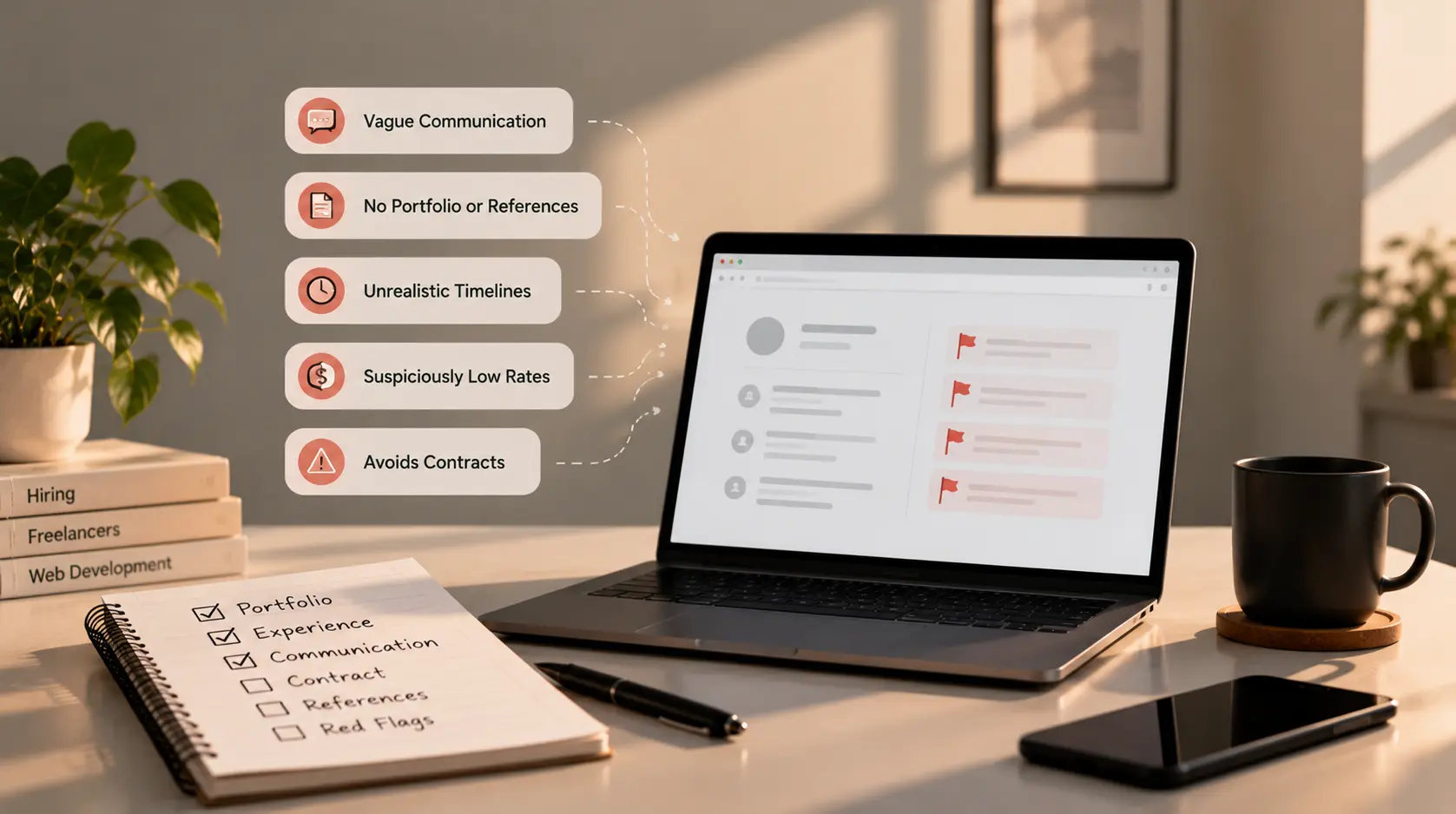
Here are ten freelance developer red flags to look for before you commit.
1. They cannot show verifiable work
A portfolio is a starting point, not proof by itself. Screenshots can be outdated, demo sites may use templates, and a developer may have contributed to a project without building every part of it.
Ask for a few relevant live websites or applications. Then ask what they personally handled: frontend, backend, integrations, deployment, bug fixes, or ongoing support. If the work is confidential, they may not be able to share source code, but they should still be able to explain their role without revealing private client information.
Ask: “Which parts of this project did you build, and what was the most difficult problem you solved?”
Watch for: broken or unrelated portfolio links, vague claims about team projects, or explanations that change when you ask follow-up questions.
A developer who has limited public work is not automatically unqualified. Newer developers may have smaller portfolios. Look for honest explanations, relevant examples, and evidence of how they approach problems.
2. They promise a price or deadline before understanding the project
A reliable estimate depends on the requirements. A simple marketing website is different from a customer portal with authentication, payments, dashboards, third-party integrations, and different user roles.
Be cautious if a developer gives a confident fixed quote after only a few minutes, without asking about users, features, existing systems, content, integrations, or launch expectations. They may be guessing—or the quote may cover only a narrow interpretation of what you asked for.
A good developer should identify assumptions and explain what could change the estimate. For uncertain work, a paid discovery phase or technical audit can be more realistic than pretending every detail is already known.
Ask: “What assumptions does this estimate depend on, and what would make the cost or timeline change?”
Watch for: guaranteed deadlines with no breakdown, no questions about requirements, or a quote that does not say what is included.
3. The proposal is vague about scope and deliverables
“Build a professional website” is not a complete project scope. Neither is “full-stack development” without a list of deliverables.
Before work starts, document what the developer will deliver. Depending on your project, that may include page templates, responsive layouts, admin features, database setup, integrations, testing, deployment, documentation, and a handover. Record what is excluded as well.
Be clear about revisions, content entry, paid third-party services, hosting, bug fixes, and changes requested after approval. A written scope protects both sides by reducing the chance that each person has a different idea of what “finished” means.
Ask: “Can you list the deliverables, exclusions, acceptance criteria, and how out-of-scope requests will be priced?”
Watch for: “everything is included” without details, refusal to put the agreement in writing, or a proposal that relies entirely on verbal promises.
4. They demand full payment upfront
Freelancers reasonably need to protect their time and cash flow. A deposit can be normal, especially for a new project. The concern is being asked to pay the entire fee before meaningful work begins, with no clear protection or delivery plan.
Consider payments tied to defined milestones—for example, discovery and planning, an approved design, a working feature set, and final handover. The exact structure should fit the project's size and risk. For work booked through a freelance platform, follow that platform's payment and protection rules rather than moving money off-platform.
Do not choose a payment schedule solely because it is the cheapest or most convenient. Make sure each payment corresponds to something you can review.
Ask: “What deliverable is attached to each payment, and how will I review or accept it?”
Watch for: pressure to transfer the full amount immediately, payment requests that bypass agreed platform protections, or refusal to define milestones.
5. They avoid a written contract or agreement
A contract does not have to be intimidating or excessively long. It should make the important terms clear: scope, fees, payment dates, milestones, responsibilities, change requests, ownership, confidentiality where relevant, termination, and handover.
Without a written agreement, it can become difficult to resolve disagreements about missed deadlines, additional costs, revisions, or who owns the finished work. A proposal or statement of work can help, but make sure both sides agree to the terms and retain a copy.
For projects involving sensitive data, regulated information, or complex intellectual property, consider getting appropriate professional advice on the contract.
Ask: “Can we document the scope, payment terms, ownership, and exit or handover process before starting?”
Watch for: a refusal to put key promises in writing, or attempts to leave ownership and delivery terms until the end.
6. You will not own or control the important accounts
This is one of the most expensive problems to discover after a project has launched. If your domain, hosting, source-code repository, analytics, email service, or cloud account is registered only in the developer's name, changing developers may become difficult.
Where practical, create business-owned accounts and invite the developer with the access they need. The code should be stored in a repository your business can access. If there is a valid reason an account must initially sit elsewhere, agree on how and when it will be transferred.
Ownership of accounts is not exactly the same as intellectual-property ownership. Both should be addressed in writing, including any third-party libraries, paid themes, fonts, or services that have their own licence terms.
Ask: “Will the domain, hosting, repository, and key service accounts be under my control, and how will access be handed over?”
Watch for: “I keep everything in my account,” reluctance to provide repository access, or no clear handover plan.
7. They cannot explain technical decisions in plain language
You do not need a developer to avoid technical terms entirely. You do need someone who can explain the important choices and their trade-offs in language you can understand.
If they recommend a particular framework, database, hosting setup, or a complete rewrite, ask why it fits your needs. A sound explanation should connect the choice to factors such as project complexity, maintainability, security, performance, existing systems, budget, and the skills available to support it later.
Be cautious when someone dismisses every question as “too technical,” uses jargon to shut down discussion, or insists that their preferred technology is always the best option.
Ask: “What are the alternatives, why do you recommend this approach, and what trade-offs should I know about?”
Watch for: unexplained rewrites, unnecessary complexity, or recommendations that seem driven by personal preference rather than your requirements.
8. They communicate poorly before you hire them
The early conversations show you how a freelancer approaches questions, clarifies uncertainty, and follows through. A missed message now and then is normal; repeated unexplained delays, contradictory answers, or ignored questions are a pattern worth noticing.
Agree on a practical communication routine before work starts. You might set a weekly update, a shared task board, and an agreed response window for normal questions. Also decide who will make decisions and how urgent issues should be raised.
A good developer should not promise to be available every minute. They should be honest about working hours, other commitments, and how they will keep you informed if a deadline is at risk.
Ask: “How will we track progress, how often will you send updates, and what happens if a milestone is at risk?”
Watch for: repeated no-shows, missed commitments without updates, or defensiveness when you ask for a clear status.
9. They promise guaranteed results they cannot control
Be wary of claims such as “guaranteed first place on Google,” “zero bugs,” “unhackable website,” or “we can build anything in a few days.” Software projects involve uncertainty, and outcomes such as search rankings depend on factors beyond a developer's control.
A professional should explain what they can deliver and how they will measure it. Instead of promising that a website will rank first, they can describe technical SEO work, page performance checks, structured data where appropriate, and how the site will be set up for measurement. Instead of promising zero bugs, they can explain the testing process and how defects will be handled.
Ask: “What exactly can you commit to delivering, and how will we verify the result?”
Watch for: absolute guarantees without a method, exaggerated claims, or promises that ignore dependencies and limitations.
10. They have no plan for testing, launch, or post-launch support
A website is not necessarily ready just because it looks complete on a developer's laptop. It may need mobile checks, browser testing, form and payment tests, permission checks, backups, deployment planning, and a way to identify problems after launch.
Ask what testing is included, where you can review work before it goes live, and who is responsible for deployment. Agree on how defects found after launch will be reported and handled. Clarify whether ongoing maintenance is included, available as a separate service, or outside the engagement.
For a larger application, ask about documentation, backups, monitoring, security updates, and how another developer could take over if needed.
Ask: “What will be tested before launch, what support is included afterward, and what will I receive at handover?”
Watch for: no review environment, no testing plan, no documentation where it is needed, or the claim that all future fixes are included without any defined terms.
How many red flags are too many?
One concern does not always mean you should reject a candidate. There may be a reasonable explanation: a new freelancer may have a small portfolio, a complex project may need discovery before it can be estimated, or a specialist may have limited availability.
Focus on the seriousness and the pattern. Missing portfolio examples may call for more verification. Refusing written terms, withholding access to your own project, or demanding full payment without a clear agreement creates a much higher risk.
Use this quick decision guide:
| Situation | Sensible next step |
|---|---|
| One minor concern with a clear explanation | Ask follow-up questions and verify the explanation |
| Several concerns about communication, scope, or estimates | Pause and compare another candidate |
| Unclear ownership or refusal to document key terms | Do not proceed until resolved |
| Pressure to make an immediate payment or bypass platform protections | Stop and verify before sending money |
| Dishonest portfolio claims or changing explanations | Consider walking away |
You can also use the questions in the Django developer hiring checklist to assess a candidate's technical experience, project approach, and fit before signing an agreement.
What good signs should you look for instead?
A trustworthy freelance developer is not someone who says yes to everything. Look for someone who:
- Asks thoughtful questions about your business, users, and priorities.
- Explains estimates, assumptions, exclusions, and trade-offs.
- Can show relevant work and clearly describe their contribution.
- Is comfortable documenting scope, payment milestones, and ownership.
- Gives realistic timelines and communicates risks early.
- Uses sensible practices for version control, testing, security, and handover.
- Respects your budget without promising an unrealistic amount of work.
- Is honest about what they do not know and how they will find the answer.
Before making a decision, compare candidates against the same brief and criteria. That makes it easier to evaluate the value of each proposal instead of choosing based only on the lowest price or the most confident pitch.
Final checklist before hiring
Before you pay a deposit or give a developer access to your systems, confirm that you can answer these questions:
- Have I verified relevant work and the developer's actual role?
- Is the estimate based on a clear project brief?
- Are deliverables, exclusions, revisions, and acceptance criteria written down?
- Are payment milestones clear and proportionate to the work?
- Have we agreed on the contract, ownership, and handover terms?
- Will my business control its domain, repository, and key accounts?
- Do I understand the major technical decisions and trade-offs?
- Is there an agreed way to communicate progress and delays?
- Are testing, launch, and post-launch support responsibilities clear?
If several answers are “no,” slow down and resolve the gaps before committing. A few extra questions at the beginning are usually easier to manage than recovering an unfinished project later.