
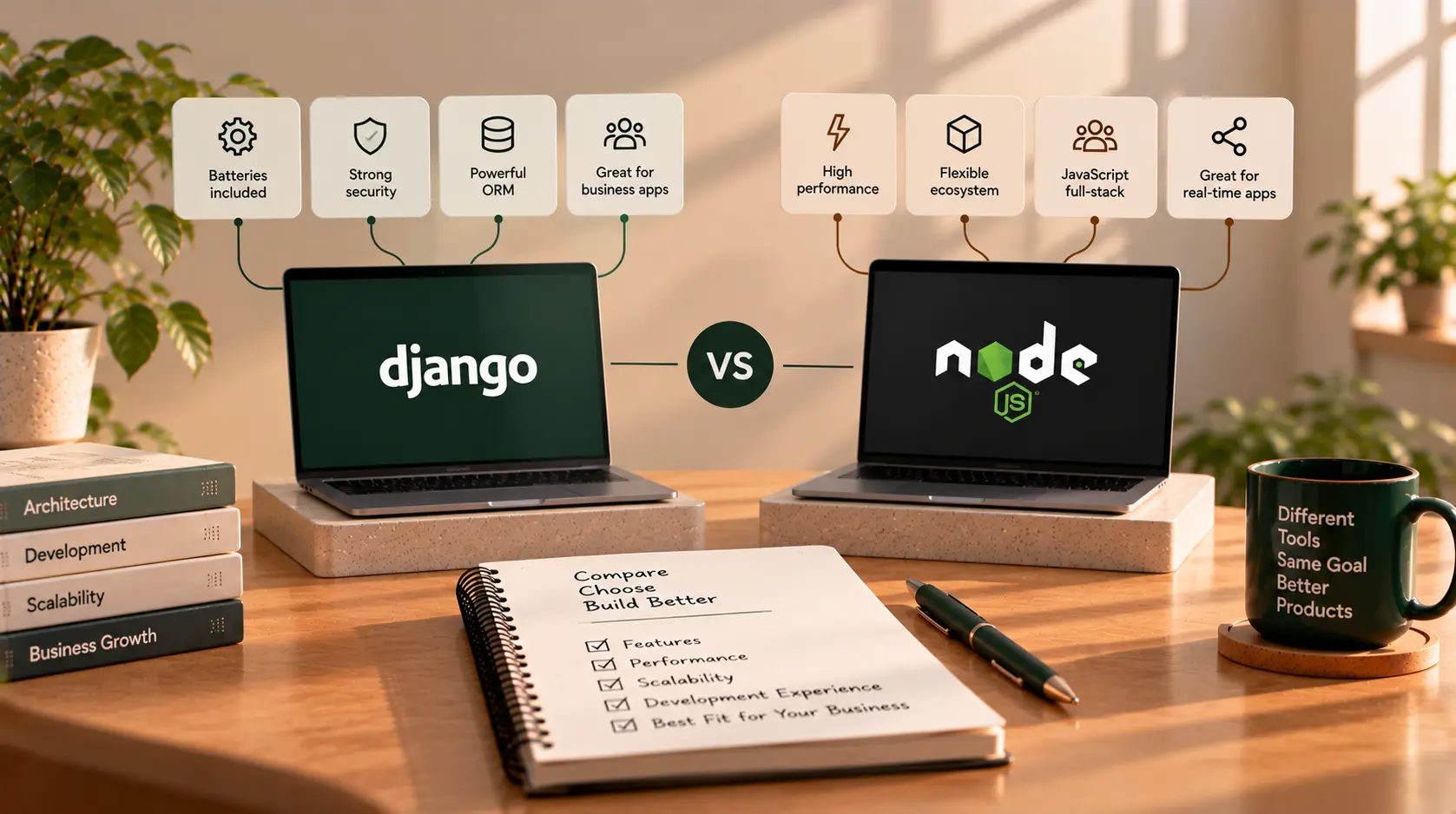
Django vs Node.js: Which Is Better for a Business Web App?
When planning a business web application, choosing the backend technology is an important decision. It can affect how quickly your team builds the first version, how the application is structured, what skills you need, and how the product will be maintained.
Two common options are Django and Node.js. Both can be used to build production web applications, APIs, and business software, but they approach development differently.
Django is a high-level web framework written in Python. It provides an integrated set of tools for common web application needs, including database models, authentication, forms, and an administrative interface. Node.js, by contrast, is a JavaScript runtime—not a web framework by itself. It is commonly paired with frameworks and libraries such as Express or NestJS to build web servers and APIs.
There is no universal winner. Django can be an excellent fit for data-driven business applications with structured workflows and administrative needs. Node.js can be an excellent fit for JavaScript-oriented teams, API-focused products, and applications with substantial asynchronous or real-time workloads. The right choice depends on the product, the team, and the requirements.
Django vs Node.js: quick comparison
| Factor | Django | Node.js |
|---|---|---|
| What it is | High-level Python web framework | JavaScript runtime used to build server-side applications |
| Common approach | Integrated framework with many built-in web features | Runtime combined with a framework such as Express or NestJS and selected libraries |
| Main language | Python | JavaScript or TypeScript |
| Built-in admin interface | Yes, Django includes an admin site | Usually added or built using a separate tool or application |
| Authentication and permissions | Built-in authentication system and permission features | Usually implemented with framework features and selected libraries |
| Data access | Django ORM and migration tools are included | Choice of database library or ORM, such as Prisma, Sequelize, or a native driver |
| APIs | Can provide APIs; Django REST Framework is a common option | A core use case, commonly built with Express, NestJS, Fastify, or other frameworks |
| Real-time and event-driven work | Possible, with suitable architecture and additional components when needed | A natural fit for asynchronous I/O and event-driven network applications |
| Full-stack language sharing | Python backend, typically JavaScript/TypeScript frontend | JavaScript/TypeScript can be used on both backend and frontend |
| Best fit | Data-driven applications, business workflows, admin-heavy tools | API services, event-driven systems, JavaScript/TypeScript teams, real-time applications |
The table compares Django with the Node.js ecosystem, not two equivalent products. Node.js requires you to choose the framework and libraries that provide the features your application needs.
What makes Django a strong choice?
1. It provides a lot of common web functionality
Django follows a “batteries included” approach. It comes with tools for URL routing, templates, forms, database models, migrations, authentication, sessions, and administration. This can reduce the amount of foundational work needed for a typical business application. The official Django overview explains these built-in capabilities.
For example, an internal operations system may need staff accounts, role-based access, customer records, forms, and a way for authorised employees to manage data. Django gives the team a connected foundation for those requirements.
This does not mean Django automatically makes every project faster. Custom workflows, complex integrations, unfamiliar codebases, and unclear requirements can still take significant effort. The benefit is that many common needs already have established solutions within the framework.
2. The built-in admin can accelerate internal tools
Django's admin interface can provide authorised staff with a way to search, review, create, update, and manage application records. Developers can customise it for the business's data and administrative tasks.
That is particularly useful for:
- Internal business tools
- Inventory and order management
- Content administration
- Staff-facing dashboards
- Early product versions where a custom admin interface is not yet necessary
The admin is not a substitute for every customer-facing interface. If the business needs a highly tailored workflow or polished portal, a separate interface may still be appropriate. But the built-in admin can reduce initial effort and help teams validate data and processes earlier.
3. It offers an integrated approach to data modelling
Django's ORM lets developers define models in Python, query records, and manage schema changes through migrations. This is helpful when a business application includes connected entities such as customers, appointments, invoices, products, subscriptions, or staff.
The ORM does not remove the need to understand database design. Developers still need to plan relationships, indexes, transactions, constraints, and query performance. Django provides a structured toolset, not an automatic solution to every data problem.
4. It has established security features and conventions
Django includes mechanisms that help developers address common security risks, including CSRF protection, template escaping, password management, and protections around ORM queries. Correct configuration and implementation remain essential: no framework makes an application secure by default in every possible situation.
A production application still needs carefully designed permissions, secret management, secure deployment settings, dependency updates, monitoring, backups, and appropriate testing. Consult the official Django security documentation and deployment checklist when planning a launch.
5. Python can be useful across the product
Python is widely used for backend development, data processing, automation, and many machine-learning workflows. If the team already works in Python, Django may let it use existing skills and libraries across multiple parts of the application.
This can be helpful for products involving reporting, data transformation, scheduled processing, or integrations with Python-based services. It does not mean Python is automatically better for every data or AI workload; the actual libraries, deployment model, and performance requirements still matter.
What makes Node.js a strong choice?
1. JavaScript or TypeScript can be used across the stack
Many teams build their frontend with JavaScript or TypeScript. Using Node.js on the backend can allow them to share language knowledge, types, validation patterns, and some tooling across frontend and server-side development.
This can simplify collaboration, especially when the team is already experienced with the JavaScript ecosystem. TypeScript can add static type checking when configured and used effectively, although it does not replace runtime validation or good tests.
2. It is designed for asynchronous network applications
Node.js uses an event-driven model and non-blocking I/O. This can be effective for services that spend much of their time waiting for network, database, or other I/O operations. The official Node.js overview describes its focus on scalable network applications, and its event-loop guide explains the underlying model.
Potential use cases include:
- API services that coordinate multiple external services
- Notification and messaging systems
- Collaborative features and real-time updates
- Applications with many concurrent I/O operations
- Backend services in a JavaScript/TypeScript-heavy environment
However, Node.js is not automatically faster for every workload. CPU-intensive JavaScript can block the event loop if it is not handled appropriately. Database design, external services, application code, infrastructure, and workload patterns often matter more than the runtime choice alone.
3. You can choose a framework that fits the project
Node.js has a broad ecosystem of frameworks and libraries. For example, Express offers a relatively minimal approach to building web servers, while NestJS provides a more structured architecture with conventions for organising larger applications.
This flexibility is an advantage when a team wants to choose its own components or needs a specific architecture. It also creates decisions and responsibilities: the team must select, configure, update, and maintain the libraries that supply authentication, validation, database access, background jobs, and other capabilities.
That trade-off is important. More choice can mean a closer fit to the project, but it can also mean more setup and integration work.
4. It can be a natural fit for real-time features
Applications with live updates, messaging, collaborative interfaces, or streaming connections may benefit from Node.js and its surrounding ecosystem. Technologies such as WebSockets can support persistent, bidirectional communication between clients and a server.
Real-time requirements still need careful design. You may need connection management, authentication, message delivery rules, queues, monitoring, and a plan for handling disconnections. Django can also support real-time architectures when combined with suitable components; the choice should be based on the actual requirements rather than a blanket assumption that only one option can do real-time work.
Which is better for common business applications?
The following examples illustrate how to think about the choice. They are starting points, not fixed rules.
| Business application | Django may be attractive when… | Node.js may be attractive when… |
|---|---|---|
| Customer portal | The portal has structured records, permissions, forms, and administrative workflows | The team already has a TypeScript backend and wants to share conventions with the frontend |
| Inventory or order management | Data relationships, staff workflows, and a built-in admin are valuable | The product relies on an existing Node.js platform or needs specialised event-driven services |
| SaaS dashboard | The product needs user accounts, database-backed features, and internal administration | The team wants a JavaScript/TypeScript stack across the product |
| Messaging or collaboration tool | Django can serve the core application and integrate with a suitable real-time layer | Real-time events and asynchronous network operations are central to the product |
| Reporting and data workflows | Python libraries and Django's data modelling suit the workflow | The system is mainly an API orchestration layer and the team is strong in Node.js |
| Internal operations tool | The admin interface and integrated web features reduce setup work | The tool is part of a broader JavaScript platform or relies on Node-specific services |
A business application can also use both technologies in separate services, but a mixed stack introduces additional deployment, monitoring, and maintenance complexity. It should solve a real architectural need rather than be added simply to use two popular technologies.
Security: neither option removes the need for good engineering
Security should not be reduced to a claim that one technology is “secure” and the other is not.
Django includes many common web protections and conventions. In a Node.js application, security depends on the framework, libraries, configuration, and implementation choices the team makes. Both approaches can be built securely, and both can be built insecurely.
For either stack, plan for:
- Authentication and carefully defined authorisation rules
- Input validation and safe handling of uploaded files
- Secure storage and rotation of secrets
- Dependency updates and vulnerability monitoring
- HTTPS and appropriate production configuration
- Logging, backups, and recovery procedures
- Testing of access controls and important failure cases
The best comparison is between the proposed architectures and the team's ability to maintain them—not between framework marketing claims.
Performance and scalability: compare the workload, not the labels
It is common to hear that Node.js is faster or that Django is easier to scale. These statements are too broad to guide a business decision.
Node.js's non-blocking I/O model can be useful for I/O-heavy applications. Django can support substantial production workloads when the application, database, caching, and infrastructure are designed appropriately. Either can become a bottleneck if queries are inefficient, dependencies are slow, or the architecture does not match the workload.
Before choosing based on performance, ask:
- What kind of work dominates the application—database queries, network calls, CPU-intensive processing, or live connections?
- How many concurrent users or requests do you realistically expect?
- Which actions need strict response-time targets?
- Can the expected workload be represented in a proof of concept?
- What monitoring and performance testing will be used after launch?
Measure realistic workflows where performance is a major concern. Do not select a technology based only on generic benchmark claims.
Development speed and total cost
The fastest path to a first version is not necessarily the cheapest path over the product's lifetime. A useful estimate should include setup, implementation, integration, testing, deployment, documentation, and ongoing maintenance.
Django may reduce setup work for applications that need its built-in features. A Node.js stack may be efficient when the team already has strong JavaScript/TypeScript experience or when its selected libraries fit the product well. Either stack can become expensive if requirements are unclear, the architecture is unnecessarily complex, or the team lacks the skills to maintain it.
When comparing proposals, ask each team to explain:
- What functionality is included in the first release
- Which framework and supporting libraries will be used
- How authentication, permissions, data access, and background tasks will work
- What testing and deployment are included
- Which assumptions and exclusions affect the estimate
- Who will maintain dependencies and handle issues after launch
Compare proposals based on the same scope and acceptance criteria. The technology name alone cannot tell you what the project should cost.
Team skills should be part of the decision
A framework is not just a technical choice; it shapes how the team works and what knowledge it needs to maintain the product.
Consider:
- Which language your team can use confidently
- Whether developers are available to maintain the application over time
- Which libraries and services the team already understands
- How the codebase will be tested, documented, deployed, and monitored
- Whether future contributors can learn the chosen architecture without excessive friction
If your team is experienced in Python and needs a data-driven application with administration and structured workflows, Django may be a natural fit. If the team is experienced in TypeScript and is building an API-heavy or event-driven product, Node.js may be a natural fit.
Do not ignore team capability in pursuit of a theoretical technical advantage. A well-built application in a familiar, suitable stack is often a better business decision than an unnecessarily complex implementation in a less familiar one.
A simple decision framework
Use these questions to narrow down your options:
Choose Django for closer evaluation if:
- Your application is centred on structured data and business workflows.
- Built-in authentication, permissions, forms, or administration could reduce foundational work.
- Your team is comfortable with Python.
- You want a cohesive framework with established conventions.
Choose Node.js for closer evaluation if:
- Your team is strong in JavaScript or TypeScript across the stack.
- The application is API-oriented or has substantial asynchronous network activity.
- Real-time or event-driven behaviour is central to the product.
- Your existing platform and supporting libraries are already built around Node.js.
Evaluate both if:
- The product has a mixture of administrative workflows and real-time features.
- Your team has experience with both ecosystems.
- Performance or integration requirements are uncertain and can be tested with a small prototype.
These are not strict boundaries. Django can build APIs and real-time products with the right architecture, and Node.js can power conventional business applications with databases, authentication, and admin interfaces supplied by its ecosystem.
Final verdict: Django or Node.js?
Django and Node.js are both valid choices for business web applications. Django stands out when an integrated web framework, data modelling, authentication, and an administrative interface align with the project. Node.js stands out when JavaScript/TypeScript consistency, asynchronous network work, or the Node ecosystem fits the team and product.
Neither is automatically more scalable, secure, modern, or cost-effective. Those outcomes depend on implementation, architecture, workload, and maintenance.
Start with the business problem and the core user workflows. Identify the data, integrations, security expectations, and real-time requirements. Then choose the technology that lets your team deliver those needs reliably without adding unnecessary complexity.
If you are planning a custom business application and want to discuss the right architecture for your requirements, get in touch with Sajid Kalam.