
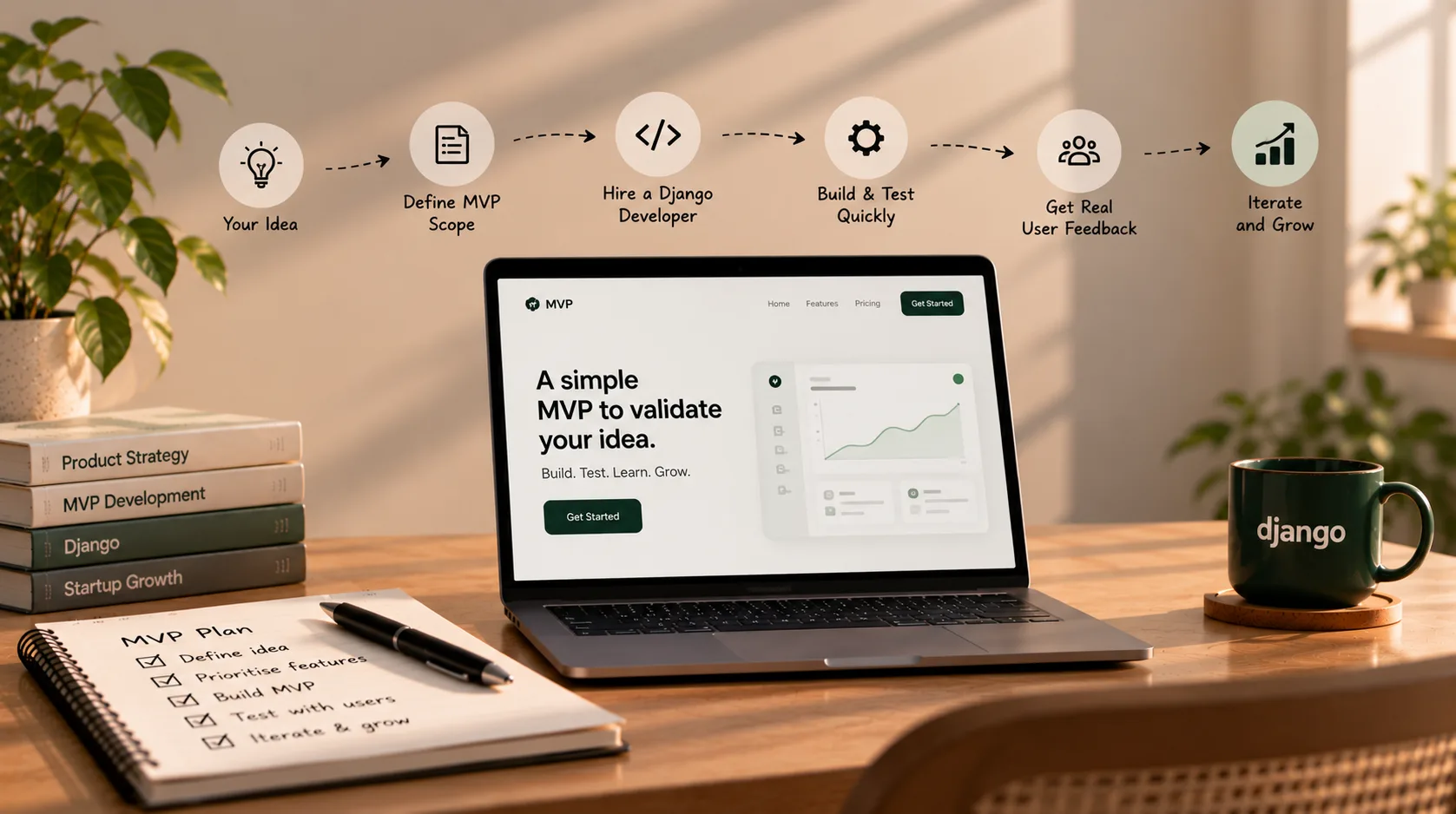
Hiring a Django Developer for a Startup MVP
You have an idea, a problem worth solving, and a list of features you would love to launch. Now you need someone who can turn that idea into a working product without exhausting your budget before you learn whether customers want it.
Hiring a Django developer for a startup MVP can be a practical choice when your product needs custom backend logic, user accounts, data management, APIs, or integrations. But the outcome depends on more than the framework or the developer’s coding ability. You need a clear first-release goal, realistic priorities, regular feedback, and a plan for what happens after launch.
This guide explains what founders should expect when working with a Django developer on a minimum viable product (MVP), what to prepare before hiring, and how to tell whether a proposal is a good fit.
What is an MVP, really?
A minimum viable product is an early version of a product that lets you test a key assumption with real users. It is not simply a smaller version of every feature you eventually want.
For example, imagine you want to build a service marketplace. Your long-term roadmap might include advanced recommendations, in-app messaging, loyalty rewards, analytics dashboards, mobile apps, and automated billing. Your first MVP may only need customer registration, service listings, a request or booking flow, an admin view, and notifications.
The right scope depends on the riskiest assumption you need to test. If the main question is whether customers will book a service, prioritise the journey from discovery to booking. If the main uncertainty is whether businesses will pay for a workflow tool, build enough of that workflow to demonstrate and test its value.
A useful MVP should be small enough to build and learn from, but complete enough to test its main use case reliably.
Why choose Django for a startup MVP?
Django is a Python web framework that includes many building blocks for developing data-driven web applications. It can be a strong fit when your MVP needs structured data, user authentication, admin workflows, forms, business rules, or APIs.
Depending on the product, Django can help you build:
- A SaaS dashboard or internal business tool
- A booking or appointment platform
- A customer portal
- A marketplace or directory
- A content-heavy or data-driven website
- A backend that serves a separate frontend or mobile application
- A workflow system with permissions, records, and integrations
Django is not automatically the best choice for every idea. A simple marketing page may not need a custom backend at all. A highly specialised real-time system may need additional architectural decisions. A good developer should discuss the product’s requirements and trade-offs instead of recommending a stack without context.
What should a Django developer deliver for your MVP?
The deliverables vary by project, but a well-scoped engagement commonly includes the following stages.
1. Discovery and technical planning
Before implementation, the developer should understand the problem, target users, key workflows, and business constraints. They may ask questions such as:
- Who will use the MVP first?
- What problem does it solve for them?
- What is the one key action a user should be able to complete?
- Which features are essential for the first release?
- What information needs to be stored?
- Are there existing services or systems to integrate?
- What budget and launch window are realistic?
The output might be a concise scope document, workflow diagrams, a data model, a list of assumptions, or a prioritised feature backlog. It does not need to become a lengthy specification. The goal is to reduce expensive ambiguity before development starts.
2. A prioritised first-release scope
Ask the developer to separate features into three groups:
- Must have: Required to test the core product and complete the primary user journey.
- Should have: Valuable improvements that can be included if time and budget allow.
- Later: Features that can wait until feedback provides a reason to build them.
This prevents the MVP from quietly growing into a full platform. It also makes trade-offs easier: if a new idea appears halfway through the project, you can decide what to defer rather than adding everything to the same deadline.
3. Backend and data modelling
Django development often includes defining the application’s data models, relationships, validation rules, permissions, and business logic. The developer should explain how important records relate to one another and how the system will protect data consistency.
You do not need to approve every technical detail. You should, however, understand the important product decisions—for example, who can view or edit a record, what happens when a booking is cancelled, and whether an action needs an audit trail.
4. User-facing workflows and integrations
Depending on the scope, the work may include templates or frontend integration, registration and login, dashboards, forms, email notifications, payment-provider integration, file uploads, or third-party APIs.
Integrations deserve explicit attention in the proposal. “Payment integration” or “connect the CRM” can conceal several tasks: configuration, error handling, testing, credentials, webhooks, and failure recovery. Ask which specific workflow is included and what depends on a third-party account or approval.
5. Testing and feedback cycles
You should expect opportunities to review working software before launch—not just a final link delivered at the end.
A typical process includes testing the main user journeys, fixing bugs, checking permissions and validation, and verifying important integrations. The amount of automated testing will depend on the complexity and risk of the application, but the developer should explain how they will check that critical features work.
Agree on review milestones and who will provide feedback. Consolidated feedback from one decision-maker usually makes the process more efficient than conflicting comments arriving from multiple people.
6. Deployment and handover
A usable MVP needs a path from the developer’s environment to a production environment. That work may include hosting setup, environment variables, database configuration, static and media files, domain and HTTPS configuration, logging, and backups.
Django’s official deployment checklist recommends reviewing security, performance, and operational settings before production. It includes items such as keeping SECRET_KEY confidential, setting DEBUG = False, configuring ALLOWED_HOSTS, using a production-ready server rather than Django’s development server, and planning database backups.
At handover, clarify that you will receive the agreed source code, repository access, deployment instructions, relevant account access, a list of dependencies and integrations, and a record of known limitations. The exact handover package should be written into the scope.
What should you prepare before hiring?
You do not need a complete technical specification to start a conversation. A short brief is enough to help a developer ask better questions and give you a more meaningful estimate.
Prepare these basics:
- Problem statement: What problem are you solving, and for whom?
- Primary user journey: What should a first-time user be able to do from start to finish?
- Must-have features: List only what is needed to test the core idea.
- User roles: For example, customer, provider, and administrator.
- Data and integrations: What information will the app store, and which external services are essential?
- Constraints: Budget range, desired launch window, compliance needs, or existing systems.
- Success measure: What would convince you that the MVP is worth improving after launch?
Avoid prescribing technical details you are not sure about. Explain the business need and let the developer propose an appropriate implementation, with the trade-offs made clear.
How long will a Django MVP take?
There is no reliable universal timeline. A focused internal tool with a few straightforward workflows may be much smaller than a marketplace with multiple user roles, payments, notifications, and external integrations.
Timeline depends on factors such as:
- Number and complexity of user journeys
- Design readiness and frontend requirements
- Data migration or integration work
- Authentication and permission rules
- Payment, email, messaging, or other third-party services
- Testing, deployment, and review time
- How quickly you can make decisions and provide feedback
Ask for a milestone-based estimate rather than a single date with no explanation. For example, a plan might separate discovery and scope, core implementation, review and testing, and deployment. Each milestone should have tangible deliverables and a clear review point.
Treat an early estimate as conditional on the agreed scope. If new features are added, ask the developer to explain the impact on cost and timing before approving the change.
How much should you budget?
The cost of hiring a Django developer varies with the developer’s experience, location, engagement model, complexity, and the amount of work included. A fixed price cannot be meaningfully recommended without understanding the product.
Instead of comparing quotes by total price alone, ask each candidate to estimate the same scope and clarify:
- What is included and excluded
- Which assumptions the estimate depends on
- How changes will be priced
- Whether testing, deployment, and handover are included
- Whether hosting, paid services, and licences are separate
- What support is available after launch
- How payment is tied to milestones or accepted deliverables
A lower quote can be appropriate for a genuinely smaller scope. A higher quote is not automatically better. Look for a realistic plan, clear communication, relevant experience, and an approach that matches the risk and complexity of your MVP.
How to evaluate a Django developer
A portfolio is useful, but you should look beyond screenshots. Ask about a project that resembles your needs and how the developer approached its requirements, data, integrations, deployment, and ongoing maintenance.
Useful questions include:
- Have you built an application with similar workflows or data requirements?
- How would you reduce my idea to a testable first release?
- What assumptions could affect the estimate?
- How would you structure the data and user permissions?
- How will we review progress and test the main workflows?
- What will I own and receive at handover?
- What happens if we need to change the scope?
- What support can you provide after launch?
You do not need a developer who claims to know everything. You need someone who can explain decisions clearly, identify risks early, ask thoughtful questions, and be honest about uncertainty.
Look for evidence of real project work, understandable communication, a transparent process, and a willingness to discuss limitations. Be cautious of guarantees that ignore the unknowns in your brief or proposals that promise a complex product in an implausibly short time.
Common mistakes startup founders should avoid
Building every idea into version one
Feature creep delays learning. Keep the first release tied to a clear hypothesis and move secondary ideas to a backlog.
Starting without agreeing on scope
Verbal assumptions often become disagreements. Write down the features, exclusions, review process, and handover expectations.
Treating launch as the finish line
A live product still needs monitoring, bug fixes, backups, security updates, and decisions based on user feedback. Decide who will handle these responsibilities.
Choosing a stack before defining the problem
Django may be a good fit, but the right technical approach should follow the product requirements. Ask the developer to explain why the proposed stack is appropriate.
Leaving ownership and access until the end
Clarify repository, domain, hosting, and third-party account ownership early. Use appropriate access controls and avoid sharing production secrets in insecure documents or messages.
Measuring success only by delivery date
A product that launches quickly but cannot reliably complete its core workflow has not achieved the main purpose of an MVP. Agree on acceptance criteria that describe what must work.
What does a healthy development process look like?
A practical engagement should give you visibility without requiring you to manage every line of code.
| Stage | What you should expect |
|---|---|
| Discovery | Shared understanding of the problem, users, constraints, and risks |
| Scope | Prioritised features, exclusions, milestones, and acceptance criteria |
| Design and planning | Key workflows, data structure, and technical approach |
| Development | Regular progress updates and reviewable increments |
| Testing | Verification of critical user journeys and resolution of launch-blocking bugs |
| Deployment | Production configuration, domain/HTTPS setup as needed, logging, and backup planning |
| Handover | Agreed code, access, documentation, and known limitations |
| Post-launch | A defined support arrangement and a process for prioritising improvements |
The exact process should fit your team and product. A small MVP does not need unnecessary ceremony, but it does benefit from clear decisions, visible progress, and written agreements.
Is a freelance Django developer right for your startup?
A freelance developer can be a good fit if you need direct collaboration, a focused scope, and flexibility. A development agency may be more suitable if the project needs several specialists at once, such as product design, frontend engineering, backend engineering, QA, and dedicated project management.
Neither model is inherently superior. Compare the actual people who will do the work, their availability, the communication process, and what happens when the project needs a skill outside the main developer’s expertise.
For an early-stage founder, the most important question is whether the working arrangement gives you the right mix of ownership, capability, speed, and cost for the product you need to validate.
Final checklist before you hire
Before signing an agreement, make sure you can answer “yes” to these questions:
- Can we describe the MVP’s main user problem and success measure?
- Are first-release features and exclusions written down?
- Do we understand the assumptions behind the timeline and estimate?
- Are review milestones and acceptance criteria clear?
- Have testing, deployment, and handover been included or explicitly excluded?
- Is ownership of code, repositories, domains, and accounts clear?
- Do we know how change requests and additional costs will be handled?
- Is there a plan for post-launch support and maintenance?
If these points are clear, you are in a much better position to compare proposals and start development with shared expectations.
Ready to discuss your startup MVP?
You do not need every technical detail figured out before speaking with a developer. Start with the problem, the users, and the smallest useful product you want to test. A good technical conversation should help you identify what to build first, what can wait, and what risks need to be addressed before launch.
If you are planning a Django-based MVP, get in touch to discuss your requirements, priorities, and possible next steps.